Showing posts with label Travel and Transport. Show all posts

Wednesday, 19 July 2017

HP Engine Oils, Kathmandu

The walls of this small petrol station near Teku Bridge, south of Kathmandu city centre, advertise two types of lubricants produced by Hindustan Petroleum Corp. Ltd.: HP Engine Oils and Milcy Turbo. HPCL is an Indian state-owned company created in 1974.


Location: Kalimati Marg, Kathmandu

Tuesday, 18 July 2017

Volvo Lubricants, Kathmandu

Together with building materials, lubricants are some of the most frequent painted signs seen along Nepalese roads. This one, for Volvo Lubricants can be found near a major thoroughfare south of the city centre.

Volvo       Volvo

Location: Guna Kamdev Marg, Kathmandu, Nepal

Saturday, 1 July 2017

Politics and tourism, Xizhou, China

Two signs await the visitor in a narrow street behind Xizhou Market Square. The first one, partly written with plastic letters stuck to the wall, partly painted, is of a political nature while the second one celebrates part of the town's history.


 共同团结奋斗共同繁荣发展
加强和创新社会管理,建设平安和谐幸福新喜洲
[Work Together for Common Prosperity and Development.
Strong and Innovative Social Management Builds a Peaceful and Harmonious Xizhou]

This is typical Chinese authorities parlance.

全国重点文物保护单位
[Major Historical and Cultural Site Protected at the National Level]

The site in question is the Yan Family Compound, the original residence of wealthy merchant Yan Zizhen (1871-1941). This beautiful example of early 20th century Bai architecture has now been transformed into a museum well worth a visit.
Apart from the aforementioned line, this sign -a brief description of the building- reads vertically from left to right. "Yan Family Compound" is written in the first column in  red: 严家大院.
It has been painted at the back of the property. The main entrance is on the Market Square.

Location: Xizhou, Yunnan, China

Tuesday, 27 October 2015

Petrol & Diesel, Hackney

A ghost sign revealed when the office block at the corner of Curtain Road and Hewett Street was demolished.


Petrol
& Diesel

Location: Curtain Road, Hackney

Friday, 2 May 2014

The Recorder of Edmonton, Edmonton

I doubt this shop by the name of The Recorder of Edmonton broke any record as there is no trace of it on the web, neither by name nor address (325 Fore Street). The design of this ghost sign would suggest it was painted after the Second World War. By the late 1970s though, hi-fi equipment dealer Teleradio had moved into these premises.

The
Recorder
Of
Edmonton
Bicycles
Specialists
Power ...ts
Motor ...es

Location: Fore Street

Tuesday, 29 April 2014

Carter Paterson & Co, Brixton

Carrier company Carter Paterson was founded in 1860 by Walter Carter, John Paterson James Paterson, and Robert Paterson. It adopted the name Carter Paterson & Co on January 1, 1869 and in 1887, it became a limited company. Its head office was located at 128 Goswell Road, EC1. Like other leading carriers, Carter Paterson & Co worked closely with the railways. In October 1933 the Big Four railway companies (Southern Railway; Great Western Railway; London, Midland & Scottish Railway; and London & North Eastern Railway) took control in equal shares of Carter Paterson & Co Ltd. The company then operated as a subsidiary of another carrier the Big Four had bought at the same time, the Hay's Wharf Cartage Company Ltd. Following the nationalisation of railways in 1948, Carter Paterson was absorbed into British Road Services.

In the late 19th century Carter Paterson was the country's largest carrier, with more than 2,000 horses in its 20 London depots. One such depot was in Mandrell Road in Brixton. The company acquired the premises, which included stables and several buildings, in 1901. These were largely rebuilt and enlarged in 1904 to meet growing demand for the company's services in the area.

CP & Co
Brixton Depot

The same text was painted twice. The original sign used a slightly larger typeface.

In 1948 the depot became the property of British Road Services but it seems BRS closed it a few years later. The property was then purchased by Danish brewing company Tuborg (see yesterday's ghost sign).

Some information about carriers in the late 19th century and their horses can be found in Chapter 3 of The Horse-World of London by W. J. Gordon, published in 1893 (the paragraphs about Carter Paterson are after the third illustration).

In 1983 a large mural, which appropriately includes horses, was painted by Jane Gifford, Ruth Blench, Mick Harrison and Caroline Thorpe. Sadly its future, and that of the Carter Paterson ghost sign, now seems uncertain as a developer has applied to build nine apartments on the site of the former depot.

Location: Mauleverer Road

Wednesday, 16 April 2014

Butlin's holiday camps, Brixton

Below Brixton's famous Bovril ghost sign is a fragment of a sign for Butlin's holiday camps. It is far less special than the one in Birmingham (the post also includes some information about the company) but is, as far as I am aware, the only one in London.

The typeface is characteristic of Butlin's adverts from the 1950s and 1960s but the blue colour for "Butlin's" makes it unusual. Indeed in the vast majority of cases the name was written in red (the very colour of the jackets worn by entertainers and stewards). The website of the Daily Telegraph has another rare example of an advert from the 1950s in which blue was used.

Even though most of the second line has disappeared, the last letters make it easy to tell what was written there. However the final line is a bit of a mystery.

Butlin's
Holiday Camps
... ...ber

Location: Windrush Square

Friday, 4 April 2014

Gravel et Duhamel, Dufresne & Galipeau, and Potato Distributors Ltd; Montreal

Like the warehouse next door, this building was built in 1857 for Victor Husdon, who rented it to various companies. The name of some of these can still be seen on the façade: Gravel et Duhamel, Dufresne & Galipeau, and Potato Distributors Ltd.

In the early 20th century Gravel et Duhamel were carriage and hardware (saddles, harnesses, paint and varnish, etc.) dealers.

Born in 1882, Candide Dufresne was educated at the Yamaehiche College and the Montcalm Commercial School. In 1906 he started working with boot and shoe maker Théodore Galipeau. Born in 1873 and educated at St. Laurent College, Galipeau spent his entire business life in the boot and shoe industry. The two founded the firm Dufresne & Galipeau in 1912. In 1920 the name of the company was changed to Locke Footwear Company, Ltd. It closed down in 1934.

Finally potato wholesaler Potato Distributors Ltd rented the warehouse between 1939 and 1968.

In chronological order, the signs read:
Gravel et Duhamel

Dufresne
& Galipeau

Potato Distributors Ltd

Location: Rue de la Commune Ouest, Montréal

Wednesday, 2 April 2014

Bruneau, Currie & Co, Townsend Co, and Smith-Anderson; Montreal

Rue de la Commune in Montreal, which runs parallel to the Saint Lawrence, is lined with former warehouses built in the 19th century, many of which still have the names of some of the tenants written across the façades or on the door jambs.

The warehouse below, originally located in front of the newly built docks, was one of three built in 1841-1842 for Robert Gillespie of Gillespie, Moffatt & Company, to a design by William Footner. It is known as Gillespie's Warehouse Number One. Gillespie, Moffatt & Co was the largest importing house in Montreal and sold a wide range of British goods. The company also traded with the West Indies and by 1837 its boats sailed regularly between Montreal and Jamaica. Even though Robert Gillespie had moved to London in 1822 and did not return to Canada, he owned the company's warehouses in Montreal. These had room for 10,000 barrels of flour, 20,000 bushels of wheat, and 7,000 to 8,000 barrels of beef and pork. They also included special facilities for inspecting, packing, and coopering pork barrels.
Upon Robert Gillespie's death in London in 1863, the warehouses passed to his heirs, who sold them in 1872 to Hosea B. Smith. After that date, they were rented to various import-export traders.

One of those tenants was Bruneau, Currie & Company, a wholesaler of flour and other foodstuffs. The company, based on Place d'Youville in Montreal (just behind the warehouse), was founded in 1880 by Louis-Philippe Bruneau and James Currie. By 1883 the company needed more storage space and rented Gillespie's Warehouse Number One. Following the death of Bruneau in 1890, Currie became the sole owner. In 1911 the company's offices on Place d'Youville were demolished to make way for a new building that housed not only its headquarters but also its warehouse. Three years later Bruneau, Currie & Co moved out of Gillespie's Warehouse Number One. The company, which moved to new premises in the early 1920s, closed down in the mid-1930s.

In 1927 the Smith family sold the warehouse to Townsend Company Limited, dealers in ships supplies, which had been renting it since 1924. However Townsend Co only used the warehouse sporadically and most of the time it was rented to various companies, including cloth manufacturer and retailer Smith-Anderson between 1943 and the late 1960s.

With several signs painted on this building, reading some parts is not easy. Three can be identified though. The oldest one, for Bruneau, Currie & Co, reads:

Wholesaler
Flour
Brand
Feed
Rolled
Oats
Grains
Bruneau, Currie & Co

The following sign, in chronological order, was Townsend's. It reads:

Townsend Co Limited
... Ship [Steamship?] Supplies

Finally, the most recent sign, for Smith-Anderson, reads:

Smith-Anderson Co
... ...

There was certainly something else written, especially on the lower part, as traces of more letters can be seen.

More palimsests can be found on each side of the door.

The sign for Bruneau, Currie & Co was painted twice:

Bruneau
Currie & Co
Warehouse
-----
Office
214
Place d'Youville
Bruneau, Currie
& Co. Limited
...
...
...
...

Of the signs for Townsend and Smith-Anderson, only the companies' names, in the upper part, are still visible. In the case of the former, it has faded so much only a couple of letters are still legible. Traces of more letters can be seen here and there but nothing that makes sense.

Here as well there are two signs for Bruneau, Currie & Co:

Bruneau
Currie & Co
Warehouse
-----
Office
214
Youville Square [?]
Bruneau, Currie
& Co. Limited
Flour
Feed
...
....

Taces of more letters can be seen but I did not manage to identify any word... apart from:

No
Parking

Location: Rue de la Commune Ouest, Montréal

Monday, 31 March 2014

Leverett & Frye, Notting Hill

The building that stretches along the western side of Powis Mews in Notting Hill was once Leverett & Frye's warehouse and ghost signs for the company can still be seen at both ends.

Since it barely sees the sun, the ghost sign as the northern end of the mews is better preserved. Two overlapping ghost signs at least, for the same company, feature on this wall.

The most recent sign reads:
Leverett & Frye
Limited
Boundary Warehouse
Bottling Stores
Packing Warehouse
& Offices
Only a few words from the older sign can still be read:
... ...
... ...
Depositories
Removing ...
In Lewes [?]
Goods Packed & Forwarded
By Road or Water
Removals by Motor
...
& 8 Elgin Crescent
... ...s

The name Boundary Warehouse certainly came from the proximity of the building to the boundary between Notting Hill, in Kensington, and Bayswater, in Westminster.

The wall as the southern end of the former depository was painted on three occasions.

Even what was written there has faded quite a bit, it is still possible to decipher a fair part of those signs but not necessarily to reconstitute each one of them.

Below is what I managed to read, irrespective of the chronological order:

Leverett & Frye
Depositories
Boundary Warehouse
Removing & Storing
A... ...
Goods Packed & Forwarded by Road or Water
Bottling Stores
Removals by Motor
Offices For ...
Packing Warehouse
... 8 Elgin Crescent, Notting Hill
1835 Phone Park ..07

Park, named after Hyde Park, was the telephone exchange for Bayswater and Notting Hill.

Location: Powis Mews

Friday, 28 March 2014

Huile Renault, Montlieu-la-Garde

This is undoubtedly one of the most colourful signs I've ever come across. Shame the upper part is hidden by a modern sign!

Actually there are two versions of the advert for Renault's motor oil on this wall.

The Société Anonyme des Huiles Renault was founded in 1911 by car manufacturer Louis Renault. It offered a wide range of lubricants not only for motor vehicles but also for boats and planes.

This is one of many ghost signs that can still be seen along the former Route Nationale 10 (N10), the trunk road that ran from Paris to Hendaye on the Spanish border, via Bordeaux. However in order to see them, one has to leave the many by-passes and newer dual carriageway sections of the road and follow the old route through the centre of villages.

Location: former RN10, Montlieu-la-Garde, Charente-Maritime

Thursday, 25 July 2013

RIP in Bexleyheath

On a recent visit to William Morris's Red House in Bexleyheath, I noticed the two ghost signs for Spiders Snooker and the shop that once sold radio, cycles and electrical goods, near the train station, had been covered with white paint. So now, instead of having two interesting signs that added a bit of colour to the brick wall, there are two ugly white rectangles.

If you missed the signs, you can visit the appropriate posts (links above) or simply look at the pictures below.

Location: Percy Road / Pictures taken in July 2009

Wednesday, 3 April 2013

Elf, Saint-Aubin-de-Blaye

In 1966 three French public companies involved in the exploration, production and distribution phases of the petrol business, the Régie Autonome des Pétroles, the Société Nationale des Pétroles d'Aquitaine, and the Bureau de Recherches de Pétroles merged and formed the Entreprise de Recherches et d'Activités Pétrolières (ERAP). However the new company became rapidly better known as Elf, after the brand that appeared throughout France on 27 April 1967.

The Elf brand was the result of a five-year long process that aimed at bringing under one banner the different networks of petrol stations controlled by the Union Générale de Distribution, a subsidiary of ERAP originally created in 1960, as well as the company's wide range of products. This major project was kept secret until the directors of ERAP gave a press conference on 27 April 1967 at 18:00. Within a few hours, 4,500 petrol stations were rebranded, staff uniforms changed and products renamed. The next morning the Elf logo, a stylized representation of the drill bit used in oil wells with colours reminiscent of the French flag, was everywhere to be seen.

One of the networks that disappeared in the process was Caltex, a subsidiary originally of California Texas Oil Company (a joint venture between the Texas Company -now Texaco- and Standard Oil of California -now Chevron) that had been acquired by the UGD.

The fact that this ghost sign includes a reference to the Caltex network would suggest it was painted shortly after the Elf brand was launched. The Elf logo is in its original colours, petrol blue, white and red. In 1985 the petrol blue colour was replaced by a cobalt blue, believed to be dynamic.

600
m
Relai Caltex
Elf

Location: D 137, Saint-Aubin-de-Blaye, Gironde / Pictures taken in May 2012

Monday, 1 April 2013

Simca, Pleine-Selve

Pleine-Selve is a small town of barely more than 200 inhabitants but being along a former Route Nationale, it has its ghost signs too. Two to be precise. Although the one below for car manufacturer Simca is almost parallel to the road, it would still have been noticed by drivers coming from the north as it is located on a slight curve at the bottom of a small descent.

Founded in 1934, Simca (for Société Industrielle de Mécanique et Carrosserie Automobile - Industrial Society of Mechanical and Automotive Body) was the brainchild of Fiat, even if the Italian manufacturer remained hidded behind a façade of French shareholders to get round protectionist measures adopted by France during the Great Depression. High tariffs had made Fiat cars assembled in France using parts made in Italy too expensive and no longer able to compete with French-made vehicles. This was why the decision was taken to undertake the whole production process in France. The new company bought the factory of bankrupt car manufacturer Bonnet in Nanterre, on the outskirts of Paris, and the first cars bearing the name Simca on a Fiat logo emerged in mid-1935. The first two Simca-Fiat models, the 6CV and the 11CV were copies of the Fiat 508 Balilla and the Fiat 518 Ardita respectively. One year later Simca launched the Simca Cinq, again a copy of a Fiat model, the 500 Topolino. Within a few months Simca became France's fourth largest car manufacturer, thanks to the rapid renewal of its offer and to more economic models. In 1938, with the war looming, Simca dropped the Fiat logo and adopted the sparrow as its emblem to match its slogan: "Un appétit d'oiseau" ("A bird's appetite").

After the Second World War, Simca strengthened its position thanks to models like the Simca 9 Aronde launched in 1951 ("aronde" means "sparrow" in Olf French). While the mechanical parts were identical to those of the Fiat 1400, the body was slightly different. Thanks to the benefits generated by sales of the Aronde, Simca bought truck manufacturer Unic in 1951 and in 1954 the French subsidiary of Ford.

In 1958 US company Chrysler acquired 25% of Simca's share. At the end of the same year Simca took over Talbot-Lago. Thanks to an influx of US money Simca, still in cooperation with Fiat, was able to begin on a new project, the Simca 1000. Launched in 1961, this successful model remained in production until 1981. In 1962 Chrysler took control of 63% of Simca. No longer able to control the French company, Fiat decided it was time to withdraw from Simca and, taking advantage of the new rules of the Common Market, created its own subsidiary Fiat France SA in 1964. Under Chrysler ownership Simca's fortunes started to decline. Bad management, an unsuccessful merger with British car manufacturer Rootes under the name Chrysler Europe, and a lack of innovation, together with the growing difficulties of Chrysler in the US explain this downfall. In spite of the success of the Simca 1100, a project initially rejected by Chrysler, Chrysler was forced to sell its European operations in 1978 to avoid its collapse in the US. The French, British and Spanish plants and the Simca brand were bought by French company Peugeot SA. Peugeot kept the Simca brand until 1980, when it decided to replace it with the Talbot one. Simca models continued to be produced until 1986 but under the name Talbot.

Simca

Location: D 137, Pleine-Selve, Gironde / Picture taken in May 2012

Friday, 29 March 2013

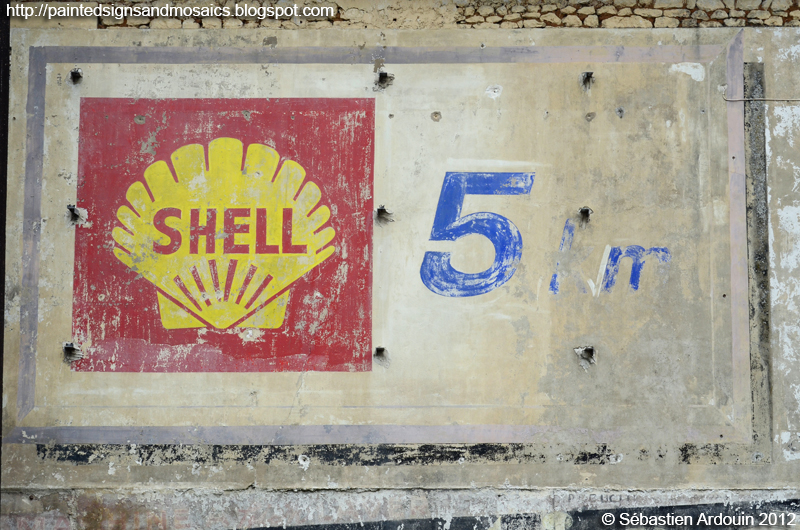
Shell, Belluire

As an introduction to a series of ghost signs found along the former Nationale 137 (reclassified as Départementale in 2006) in the départments of Charente-Maritime and Gironde in southwestern France, what could be better than one for a petrol station, where we could refill in order to carry on and discover more ghost signs.

As it is often the case with signs for petrol stations, it is located a few kilometres away from the petrol pumps themselves 1. In this case one had to drive for another five kilometres before reaching Shell's forecourt in Saint-Genis-de-Saintonge.

This particular design for the Shell logo, with the yellow shell on a red square rather than with a red outline only, was used between 1961 and 1971.

Nowadays there is still a petrol station about five kilometres further south but it is part of the network of one of Shell's competitors, Total.

This ghost sign was painted over an earlier, and wider, one with a white background but it is not possible to tell what was advertised there.

1: for another example, click see another here.

Location: D 137, Belluire, Charente-Maritime / Pictures taken in 2012

Monday, 25 March 2013

Smithfield Garage, Birmingham

The former Smithfield Garage in Digbeth, an industrial district immediately to the east of Birmingham centre, has a date of 1923 above one of its entrances. According to Andy Foster, author of the Pevsner Architectural Guides. Birmingham, it was built by Harry Weedon, an architect best known for his Art Deco factories and the Odeon cinemas.

While the entrance above has a nice sign with raised letters made of cement, one has to look to the adjacent part of the building to find a long and colourful ghost sign painted on wood.

In the early 1960s Rover cars were available from Smithfield Garage Limited. However it is as a car dealer for Volkswagen / Audi and BMW, between the 1960s and the late 20th century, that Smithfield is essentially remembered. By then Smithfield had been taken over by Hartwell and the official name changed to Hartwell Smithfield.

Smithfield Garage Limited

This building may not be standing for much longer. Indeed redevelopment projects in the Digbeth area may have been put on hold because of the current economic crisis, but plans have already been approved and many former industrial buildings are bound to disappear sooner or later.

Given the length of this sign and the narrowness of the street, several pictures have been stitched to create the complete front view of the ghost sign below.

Location: Meriden Street / Pictures taken in May 2012

Friday, 22 March 2013

Bordesley cattle station, Birmingham

Bordesley station, on the former Great Western Railway (GWR) Oxford to Birmingham line, opened in 1855. Located near Birmingham's cattle markets (their location in Deritend and Digbeth changed over the years but they remained less than a kilometre away), the station included facilities to handle cattle trains. The cattle dock was on the northern side of the station, with access onto Upper Trinity Street. It made use of the space created when the Duddeston Viaduct was built and the shunting line extended onto the viaduct itself. It is on the parapet of this viaduct, one of the country's railway follies, that today's ghost sign can be found.

Looking at Duddeston Viaduct from the north. Bordesley Viaduct is in the background.
The latter carries the line of the former GWR across the Rea Valley, between Bordesley and Moor Street / the eastern portal of the Snow Hill tunnel.

Duddeston Viaduct in Birmingham is a folly indeed. It is the city's "Viaduct to Nowhere", a piece of Victorian engineering the Great Western Railway (GWR) never wanted to build and the London & North Western Railway (L&NWR) never really intended to use. Here is why.

The London & Birmingham Railway reached the city in 1838 and in cooperation with the Grand Junction Railway built a terminus in Curzon Street. However this station was inconveniently located on the northeastern edge of the city and over the following years the different companies serving the city lobbied local authorities and Parliament for the authorisation to build a more central station.

In 1846, the year the London & Birmingham Railway, the Grand Junction Railway, and the Manchester and Birmingham Railway merged to form the L&NWR, Parliament passed the Act authorising a new company, the Birmingham and Oxford Junction Railway, to lay its tracks between the two cities. For several years the L&NWR had managed to delay the approval of such a project. As it controlled most of the traffic between Birmingham and the south, the L&NWR did not want a new line that would connect with the tracks of the GWR at Oxford to be built as it would offer an alternative route to London (although to be fair, the route via Oxford to London Paddington was much longer than the direct L&NWR route into London Euston). The L&NWR did not lose out completely as the Act granted it running rights over the new line as far south as Banbury. Yet the L&NWR had to accept, reluctantly, to provide access to its Curzon Street station to the B&OJR. Thus in order to connect the tracks of the two companies, a viaduct was to be built by both companies between Bordesley and a point in the vicinity of Curzon Street station.

At the same time it voted the bill creating the B&OJR, Parliament authorized the construction of not one but two new stations closer to Birmingham city centre: New Street and Snow Hill. While New Street would be built by the L&NWR and the Midland Railway, Snow Hill was to be operated jointly by the Birmingham, Wolverhampton and Dudley Railway coming from the north and the B&OJR coming from the south. As they were to use the same facilities in Birmingham the latter two companies decided to merge during their first general meeting. Actually these were nothing but speculative railways, whose promoters, having been granted the right to build a line, sought to sell or lease them to one of the established railway companies for a large profit. In that case the directors approached the GWR, which agreed to pay £30 5s 0d for each £20 share! However the L&NWR countered the move by buying as much shares as it could to control the company, replace the board of directors, and get new ones to repudiate the deal with the GWR. The bitter battle between the L&NWR the GWR that ensued eventually ended in the House of Lords and in 1848 the Lord Chancellor ruled in favour of the original agreement with the GWR. Brunel's company had its access to Birmingham! Since the company it had acquired had been granted the right to build its own station, Snow Hill, and since its runnning rights on L&NWR's tracks did not extend beyond Curzon Street station into New Street, the GWR lost any interest in the link with the L&NWR. As for the L&NWR, it had no intention of using its running rights to Banbury. Yet in spite of this lack of interest on both sides, the L&NWR still insisted the GWR complied with the Act of Parliament and build the Duddeston viaduct.

Construction started c. 1848 and in February 1853 Brunel reported that his company had reached the limits of the L&NWR's property. However the rest of the viaduct was never built and the junction with the L&NWR at Curzon Street never made. To this day Duddeston viaduct ends abrupty after 325 metres and its brick arches stand as a memorial to the battle the two biggest railway companies in the country fought during the Railway Mania of the 1840s.

Bordesley
Cattle Station. G.W.R.

Note the manicule immediately to the left of 'Cattle' pointing towards the entrance of the cattle station in Upper Trinity Street.

Given its position on the north side of the viaduct, and since there is no equivalent on the south side, it can be assumed this ghost sign was painted after 1897. Indeed before that date the main livestock market was at Smithfield and this sign would not have been visible from the route taken by farmers and their cattle. In 1892 Birmingham Corporation decided to relocate the pig market from Smithfield to a site in Montague Street, further west from the centre (incidentally, this is the street where Duddeston Viaduct ends). Opposition from the pig trade delayed the move but it was eventually completed in 1897. One year later cows and sheep also left Smithfield for Montague Street. Heading from from Montague Street towards Bordesley Cattle Station, farmers would have gone southward and emerged into Adderley Street, where they would have been able to catch sight of this sign.

Bordesley goods station closed in 1964. The cattle station would have closed at the same time if not earlier.

The Warwickshire Railway website has a picture of some cattle wagons at Bordesley cattle station and information about the cattle trains.

Location: Adderley Street / Pictures taken in May 2012

Tuesday, 15 January 2013

Bus companies, Bagan

During a recent holiday in Myanmar (hence the near absence of posting over the past few weeks) I came across hundreds of painted signs, mostly on wood and metal. With our days already very busy, I photographed only a fraction of them. Below is a small selection from the bus station of Nyaung U, which serves the Bagan area famous for its thousands of temples built between the 11th and the 13th centuries.

Some of these signs include elaborate drawings of buses.

The bus station consists of a row of open offices for the different companies that serve the town.

The Burmese script is very elegant, if slightly difficult to decipher for the average visitor to the country. Fortunately, there is always someone willing to help.

The Latin script is very rarely seen on painted signs. Only a handful of companies that target tourists use it to advertise their services.

Location: Main Road, Bagan / Pictures taken in January 2013

Friday, 14 December 2012

Garnier & Poupin, Matha

A simple painted sign for a local garage in the small town of Matha in the northeastern corner of the Charente-Maritime département. Even though an ampersand links the two names Garnier and Poupin on this sign, the name of the garage is now simply Garnier Poupin.

Garnier & Poupin
Carrosserie - Automobile [Car Bodywork]

Location: Boulevard de Satin-Hérie, Matha, Charente-Maritime / Picture taken in January 2011