Showing posts with label Matches and Tobacco. Show all posts

Monday, 7 August 2017

Gold Flake Cigarettes, Sankhu, Nepal

After the painted sign for Yak Filter, here is another one for different brand of cigarettes. Sankhu starts to look like a really unhealthy place!

गोल्ड
फ्लेक
[Gold
Flake]


Note the company's full name on the strip closing the packet and its shorter version above the logo with the rhinoceros.

नेपाल टोवाको कम्पनी
(प्रा) लि
नेपाल
[Nepal Tobacco Company
(Pvt) Ltd
Nepal]

नेपाल
[Nepal]

Location: Sankhu, Nepal

Wednesday, 2 August 2017

Yak Filter Cigarettes, Sankhu, Nepal

Yak Filter is one of several brands of cigarettes manufactured by the Janakpur Cigarette Factory. The company was founded in 1964 and is based, as the name suggests, in Janakpur, in the lowland region of Terai, not far from the border with India.

याक
फिल्टर
जनकपुर चुरोट कारखाना लि
[Yak
Filter
Janakpur Cigarette Factory Ltd]


The cigarettes advertised here come in packs of 20.


Location: Sankhu, Nepal

Wednesday, 23 September 2015

Schuhmacherei, Pirna

Before these premises were taken over by shoemaker Kun, there was a shop selling spirits and cigars (the name was painted above the windows but only a few letters can still be seen).


Schuhmacherei Kun
Spirituosen
Cigarren


Spirituosen


Cigarren

Location: Obere Burgstraße, Pirna, Sachsen

Tuesday, 22 April 2014

Tali Jagat Raya, Banyuatis

A stop along the road between Munduk and the north coast of Bali to look at rice terraces in the morning sun also provided an opportunity to take a picture of a recently painted sign.

Tali Jagat Raya is a brand of cigarettes manufactured by the Bentoel Group, Indonesia's second largest tobacco company and a subsidiary of British American Tobacco.

Tali Jagat
Citarasa nikmat
Tali
Jagat
Raya
Merodok dapat Menyebabkan kanker, serangan jantung,
impotensi dan gangguan kehamilan dan janin.

Tali Jagat
Delicious Flavour
Tali
Jagat *
Filter
Smoking can cause cancer, heart attacks,
impotence and during pregnancy can harm the foetus.

*: "Tali Jagat" means "Rope of the Universe."

Location: Banyuatis, Bali, Indonesia

Friday, 28 June 2013

Criterion and Gillette, Kilburn

Along Kilburn High Road is a great painted wall that combines two ghost signs: one for Gillette Safety Razors and one for Criterion, the safety matches that came in from the cold.

In the 1920s the British market for matches was largely dominated by Brymay. Over the years the company originally founded by Francis May and William Bryant in 1861 had merged or bought many of its competitors. However in 1930 two new brands landed in British shops: M.S. and Criterion, which came both from the Soviet Union.
The arrival of these two brands was part of a Europe-wide strategy by the Soviet authorities to regain a foot in countries where its manfacturers had been major players before the First World War and to counter the advance of Kreuger and Toll's Swedish Match Company. Kreuger, a great and extremely wealthy businessman (who would also be known after his death as one of the world's greatest swindlers), had increased dramatically the presence of his trust across most Europe and had even managed to secure a virtual monopoly in several countries in return for awarding large loans to their governments. As a result throughout the 1920s Soviet match manufacturers lost precious markets like Germany. The answer of the authorities in Moscow was to increase production from 4,000 million boxes before the Revolution to 7,000 million boxes by 1927-28 in order to flood the markets. In a bid to increase their share and ultimately drive out competition, matches made in the USSR were often sold at reduced prices, leading to accusations of dumping. Soviet brands also ran reward schemes. Although the British market was different and the share held previously by Russian manufacturers was negligible, it was a potentially lucrative market. This explains why this Soviet "offensive" finally reached Britain in 1930.
During the 1930s adverts for Criterion Safety Matches appeared in the press and in the streets. Several, like today's ghost sign, emphasised the company's gift schemes. Criterion was sold in packets of 12 boxes of around 45 matches and customers had to collect the labels to claim their rewards. For 100 labels they would get 7 lbs of fruit bonbons. If they did not give in to their kids and managed to collect 1,500 labels, they could get either a guitar or 1 lb of Russian caviar. Finally, with 1,700 labels, they could decorate their living room with a fine rug from Turkistan. Additionally some labels could win lucky customers cash prizes of £275 (£275 in 1939 is equivalent to £15,000 in 2012).
In spite of these efforts, Criterion safety matches do not seem to have been able to gain a firm seat in Britain (at least they are barely mentioned in documents and books about the matches market). The Second World War would have disrupted both production and the supply chain and efforts to come back once the war ended do not seem to have paid. Criterion matches may have remained available for a few years after the Second World War but seem to have disappeared from British homes by the late 1950s.

This ghost sign for Criterion was painted over an earlier one for Gillette Safety Razors.

Criterion
Matches
Buy
Gillette
Safety Razor

Great Gift
Scheme

Pack of Criterion Matches / British Made

Save the
Packet Labels

The Gillette logo (the name in a lozenge) is partly hidden by the lower left corner of the matchbox.

While Gillette emphised its razors were "British Made", on the drawing of the matchbox the sign painter has not included the mention "Foreign Made", which featured on the packs themselves. The mention "Foreign Made", which was found on the first versions of the Criterion labels, was later replaced by "USSR Made." The sign painter did not include the words "Damp Proof" either. This may simply be because it would have cluttered the matchbox.

Impregnated
Safety Matches
Criterion
Registered Trademark
Average ... Matches

The matchbox on this wall, and in particular the design of the scrolls above and below "Safety Matches Criterion", match the one seen in a 1936 printed advert. On later designs (those with the mention "USSR Made"), the scrolls are straight and no longer rippling. The number of matches mentioned in the early designs varies between 45 and 50. Unfotunately the figure on the wall has completely disappeared.

Great Gift
Scheme

Save the
Packet Labels

Location: Messina Avenue / Pictures taken in August 2009

Tuesday, 19 March 2013

Player's Navy Cut, Birmingham

Yesterday's ghost sign for the Continental Cafe was not the only one painted on this building in the Diritend district of Birmingham. High above the street and looming partly above the roof next door another ghost sign can be seen indeed.

Even though half of it is now missing, it is possible to recognise an advert for Player's Navy Cut cigarettes. This version is far less elaborate than the ones found in Shepherd's Bush or Homerton.

Player's
Navy Cut
Cigarettes

Location: High Street Deritend / Pictures taken in May 2012

Monday, 27 August 2012

Brymay, West Norwood

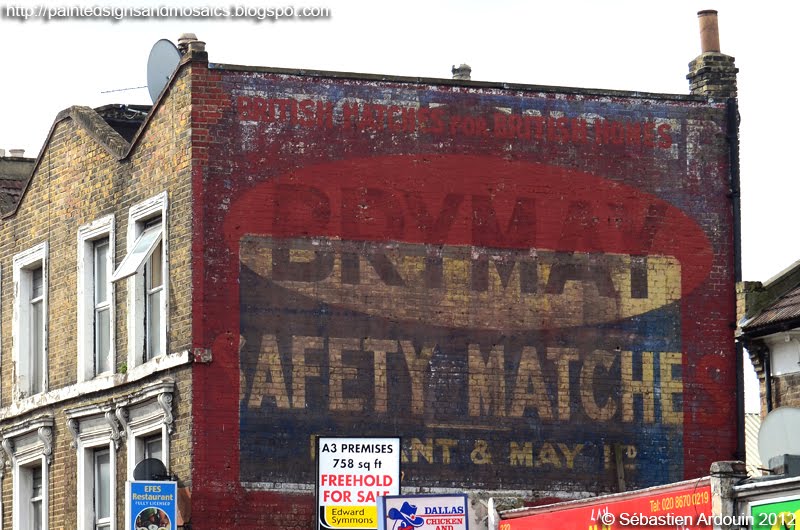
Some weeks ago the removal of a hoarding revealed the missing part of the Nestlé ghost sign in Clapham. In West Norwood, it is a Brymay ghost sign that has now fully reemerged.

March 2010

The blue and yellow colours are characteristics of Brymay's signs but the wording is slightly different from that of the better-known ghost sign from New Cross.

British Matches for British Homes
Brymay
Safety Matches
Bryant & May Ltd

Westminster
Gazette

The Brymay sign was painted over an earlier one for the Westminster Gazette. For some information about this Liberal newspaper, please see the earlier post about the Criterion, Westminster Gazette, and Gillette ghost sign in Stoke Newington.

Location: Norwood Road / Pictures taken in March 2010 and August 2012

Monday, 30 July 2012

Brymay, Fulham

This is undoubtedly one of the most colourful ghost signs for Brymay matches I have come across.

After importing Swedish matches for eighteen years, Bryant & May opened their first factory in 1861 in Bow. The site became famous in July 1888, when 1,400 women and teenage girls working there went on strike following the unfair dismissal of one them. If that was the spark that ignited the struggle, the protest was about poor working conditions, and in particular long hours with very few short breaks, heavy fines often handed to workers by foremen, and poor health resulting from exposure to white phosphorus. The matchgirls received the support of many socialists, including women's rights activist Annie Besant, who addressed the crowds on several occasions. Ultimately after more than two weeks, the management of the company agreed to meet most of the demands of the strikers.
Production of matches continued in Bow until it was transferred to Liverpool in 1979.

For British Home
Brymay

Although it is no longer visible, we can assume the first part of Brymay's slogan, "British Matches", was originally painted above "For British Homes."

Location: Lillie Road / Picture taken in May 2008

Wednesday, 4 January 2012

High class confectioner, Willesden

First of all, a very happy New Year to all the readers of this blog.

Today's story isn't that happy though. Indeed, while sometimes ghost signs emerge when modern billboards are removed or buildings demolished, the opposite is also true. Actually it even seems to be a more frequent occurence. To a certain extent this is the case with the ghost signs below, painted on a wall adjacent to the Spotted Dog on Willesden High Road. Unfortunately the last pints were poured on 20th May 2007 and the pub, which had opened in 1762, was earmarked for redevelopment in 2008. Last November, after fetching our visas for Cambodia at the embassy nearby (it saved us queueing at the border, plus I was kindly offered a CD of Cambodian music), I wandered through Willesden and noticed that work on the site was now well under way. The new complex, a combination of flats and retail units which retains the Georgian façade, extends over the alley that runs between the pub and the building with the ghost sign. That's where the problem lies. For the floors above the alleyway to stand, a massive pier has been erected and obstructs most of the ghost signs. Thus Mr Humphrey and Stepani, whose only trace left seems to have been these painted signs, are sinking further into oblivion.
Indeed the space on this wall was used on several occasions. The first sign painted there promoted a business by the name of Humphrey (the letters emerge between the larger ones of 'Stepani'). Since none of the other words found on this wall uses the same straightforward typeface, I believe the rest of this sign disappeared completely when the two newer ones were painted. The next sign advertised Stepani & Company, suppliers of ice and water (that this sign was painted next to a pub is slightly ironic). Was Stepani (but no longer '& Co') also the high class confectioner mentioned in the third sign? The absence of a name would suggest so. But then why wasn't the whole space used? Maybe a small structure, such as a hut for a newspaper seller, hid the left of the wall but didn't go as high as 'Stepani'?

. Stepani
& Company
Makers of Pure ...
Ices Supplied for Parties ...
Iced Mineral Water ...
High Class
Confectioner
Caterer and Tobacconist
... of Havana Cigars
Try a
Freshly Made
Cup

With regards to the last three lines, which undulate elegantly and were painted partly in black ('Try a Freshly'), partly in white ('Made Cup'), I think they related to a part of the sign that disappeared when part of the wall was rebuilt. Freshly grounded coffee maybe? Something was painted to the right of these lines but I can't identify what this is.

Location: High Road / Picture taken in August 2009

Wednesday, 26 October 2011

Tobacco, Camberwell

A building near Camberwell Green used to have two ghost signs for completely different products: one designed to improve one's health and one causing long-term damage. Indeed on its north side a painted sign promoted the 'miracle' medicine Beecham Pills, while on its south side another sign pointed to the main product sold by a tobacconist.

Tobacco

There was most certainly something written to the left of 'Tobacco' but it has faded too much to be able to read anything.

Location: Denmark Hill / Picture taken on: 11/04/2008

Friday, 30 September 2011

Marshall, importer of segars, Finsbury Park

The vast majority of signs posted on this blog are directly painted on walls. However the one advertising Marshall's business consisted of cement letters, painted in white, and inserted into a thin concrete layer resting against a brick wall.

Marshall.
Importer of Segars
Wholesale & Retail
Islington

A couple of letters have fallen, showing the recess in which they were fitted. Some letters may have been replaced at some point as some look slightly newer and the level of finish is not the same everywhere.


The rather unusual spelling 'segar', instead of 'cigar', was actually relatively common until the second half of the 19th century, even if several publications pointed it was incorrect as the word came from the Spanish 'cigarro.'

Location: Finsbury Park Road / Pictures taken on: 01/04/2008

Tuesday, 12 July 2011

Brymay, Acton

Construction on the site of the former Acton tram depot is progressing and very soon the Brymay sign below will disappear.


The design of this post-WW2 ghost sign for Bryant & May, the country's leading manufacturer of matches, is virtually similar to the one in New Cross.

Brymay
Safety
Matches

Although the upper part has now faded too much, one can assume the slogan "British Matches For British Homes" stood above the Brymay logo.

Location: Uxbridge Road / Picture taken on: 11/07/2011

Monday, 4 July 2011

Player's please, Homerton

In 1924 George Green, advertising manager at John Player & Son Ltd, came up with the slogan "Player's Will Please You", replaced later by "They're Player's and They Please." By the early 1930s Green shortened these rather ordinary slogans and launched the highly successful "Player's Please!" Not only this was short and catchy, but it could take two different meanings, depending on whether "please" was understood as a verb or an adverb. Indeed it could either suggest, as with the earlier versions, that Player's cigarettes would give the smoker pleasure (as well as bad breath and a few health problems including cancer) or it could be what a customer would say to a tobacconist. Additionally by using such a common sentence Green could appeal to virtually everybody (*). Thus this inclusive slogan, together with the familiar image of the Royal Navy sailor Hero, explained to a large extent the success of Player over its competitors during the interwar period and immediate aftermath of the Second World War.

*: however Player's cigarettes appealed more to middle-class southern England and never really conquered the north of Britain, where working classes preferred the Woodbine.

Player's
Please

Location: Kenney's Street / Picture taken on: 17/02/2010

Wednesday, 2 March 2011

The Golden Horn Cigarette Company, Shoreditch

The pictures below were taken before the premises reopened as a trendy men's clothing shop. Fortunately they kept the old signage for The Golden Horn Cigarette Company.


The only mention of The Golden Horn Cigarette Company I found was in a late nineteenth century (no precise date) issue of The Anglo-Indian and American Traders' Journal. It briefly said, as one could have easily guessed from the oriental name, that it imported and manufactured the best Turkish tobacco.


The letters chosen for the name, in particular the 'O', are rather unusual with their little hooks (I'm sure there is a proper term for that).


Even though there would have been enough space, the sign writer certainly thought the right end would look too cramped with 'Company' written in full, while 'Co' would have been too isolated. Hence the unusual abreviation "Comp'y."


Location: Shoreditch High Street / Pictures taken on: 16/07/2009

Tuesday, 4 January 2011

Gillette, Criterion and Iron Jelloids, Southwark

Happy New Year to all my readers! If you haven't done so, I invite you to visit my other blog for a festive picture.

Meanwhile on this blog I shall start 2011 by looking at a disappeared palimpsest. Unfortunately the building it was on was restored a few months ago and the painted signs disappeared in the process. Prior to that act of vandalism, three adverts could be seen above the entrance to a newsagent's.


Modern signs for The Times, The Sun, Today, and News of the World used to hide the lower half but a close look at the upper part revealed a combination of three products well-known to aficionados of ghost signs.


The most faded sign was for
Iron
Jelloids

For some information about these sub-carbonate of iron and jujube mass tablets and the company that made them you can refer to an earlier post about the Windsor Road ghost sign.

The other two signs are much easier to read. One promoted
Gillette
Safety
Razor

while the other one encouraged customers to
Buy
Criterion
Matches

This isn't the only wall occupied successively by these brands. A combination of Gillette and Iron Jelloids can be seen in Clapham High Street (first sign of the post), while a palimpsest with Criterion and Gillette still adorns Stoke Newington Church Street. Other walls with those three products will be posted in the future, so keep visiting!

Location: Southwark Bridge Road / Pictures taken on: 10/04/2008

Monday, 2 August 2010

The Parade, South Ealing

The end wall of a Victorian shopping parade provides the perfect support for this sign.

The Parade
News
Agency &
Tobacco &
Cigar Stores

Location: Venetia Road / Picture taken on: 30/07/2010

Saturday, 31 July 2010

Jaguar and a corner shop, Bath

Traces of two painted signs can still be seen on this wall.


The first one is for the well-known luxury car manufacturer: Jaguar. It seems the winged logo was used for about a decade after the Second World War.


Something was written under the logo. It ends in '..an' but the rest has faded too much.

The second sign is for what was certainly a corner shop.

The Corner House
...arettes [Cigarettes] ....

Location: Crescent Lane, Bath, Wiltshire / Picture taken on: 17/07/2010

Monday, 28 June 2010

Nestlé, Criterion, Redfern, and more; New Cross

Like yesterday, here is another palimpsest but at least this one is a bit easier to read.


The most recent sign advertises:
Nestlé
Milk
Richest in Cream


Prior to Nestlé, this wall carried an advert for Redfern's, a company far less known that the Swiss multinational but whose painted signs can still be seen in several locations across London. Here only 'Redfern's', slightly above 'Nestlé' has survived. Whether it was rubber heels, mats, or another of the company's rubber goods that was advertised here I don't know.
I shall write a bit about Redfern's Rubber Works tomorrow.

It seems Redfern's used the blue background of the previous sign for:
Criterion
Matches
With the open box of matches, it is similar to those found in Stoke Newington and Kilburn (this one will be for a later post).

That's it for the easy part. Several other signs were painted over time on this wall and I wonder whether one wasn't for Gillette. After all signs for Criterion and Gillette are often found together.
Then just below the 'N' of 'Nestlé' are some words written diagonally. They seem to be:
Greetings ...
School ...

Partly hidden by the 'ILK' of 'Milk' is:
B...e &

Between 'Milk' and 'Richest in Cream' are:
...te and S...

Finally at the same level as 'Richest in Cream' is:
... Talking [?] ...

Location: New Cross Road / Picture taken on: 23/07/2009

Tuesday, 22 June 2010

Brymay and Westminster Gazette, Ravenscourt Park

Once again there is more than meets the eye on this wall at the end of King's Parade.


The most obvious sign is for the Brymay brand of matches, manufactured by Bryant & May. Although the space available on this wall is by no means small, Brymay's characteristic yellow oval background had to be squeezed. If the usual proportions had been respected, the name would have been much smaller and consequently less noticeable by the passing public. Unfortunately the lower part of the sign has been lost under graffiti and then a coat of red paint.

This sign was painted over at least two other signs, including one for Liberal newspaper the
Westminster
Gazette

The other one is more of a mystery as the only part still visible spells:
The El... [?]


Also a bit of a mistery are the two words painted between the two windows:
Use
The
Were they part of the text that went with one of the ads to the right of the window or were they used to promote another product or service?

Location: Goldhawk Road / Picture taken on@ 31/07/2009

Saturday, 19 June 2010

Army Club, Seven Sisters

Earlier this year several billboards were removed along High Road in Tottenham, revealing some long forgotten adverts. One of these promoted Army Club cigarettes.


Manufactured by tobacco company Cavenders of Manchester, Army Club made history by being the first product to be advertised by neon sign in Britain. Erected on a thirty-five feet long by twenty feet high display, it was switched on on Picadilly Circus in 1924.
In the aftermath of the First World War, Army Club advertising campaigns played heavily the nostalgia card. The image of the mildly smiling officer smoking casually his fag was an attempt at bringing back memories of wartime camaraderie and male, if not macho, attitude and behaviour. As proclaimed on one of their printed adverts:
Army Club
The front-line cigarette
This is a cigarette for the fellow with a full-size
man's job to do. When you're feeling all 'hit up',
it steadies the nerves.

If you ask me, this is complete bull... Still given the popularity of the brand between the wars, it must have worked...

One if not two earlier signs were painted on this wall. Several letters can be seen here and there, in particular at the same level as 'Club.'

Location: High Road / Picture taken on: 17/02/2010