Showing posts with label Camberwell. Show all posts

Thursday, 6 December 2012

Gentlemen's hosiery, Camberwell

A short lane linking Denmark Hill and Coldharbour Lane in Camberwell has two gems: a ghost sign and a mural. The ghost sign advertised Turner's hosiery shop for gentlemen. I have not found any information about it but it was most certainly located on Denmark Hill.

...st
& Cheapest
House
For
Gentlemen's
Hosiery
Is
L. I. [?] Turner's
...

With only part of the first and the last two letters still visible, the first line could have been either 'The Best' or 'Largest'. Strangely, 'Cheapest' is written in lower case when the rest of the ghost sign is in upper case.

I could not resist posting a picture of the mural at the back of the building, inspired by one of the most famous Japanese woodblock prints: Hokusai's The Great Wave off Kanagawa, published in the early 1830s. Obviously this is not a faithful reproduction as the wave is progressing in the opposite direction (the presence of the house next door made this necessary as the dramatic impact of the composition would have been lost should the wave have been about to break on a Victorian brick house!) and the oshiokuri-bune (the fast boats used to transport live fish) have been omitted. However Mount Fuji still appears in the background.

Location: Coldharbour Place / Pictures taken in July 2009 and April 2008

Thursday, 5 April 2012

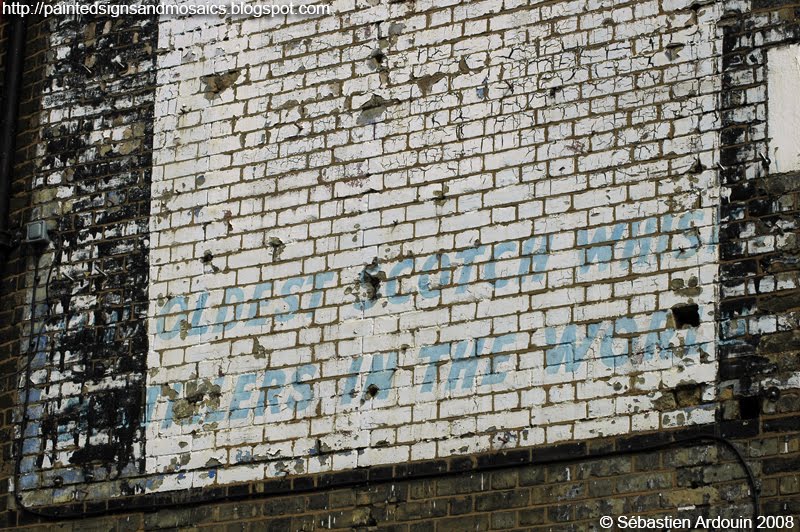
Haig whisky, Camberwell

The story of Haig whisky goes back to 1627, the year Robert Haig set up a distillery near Stirling. But this was just the beginning. The story, together with lots of information about how scotch whisky is made, is told in the promotional documentary "Scotch by Haig," shot in 1979.

This prominent ghost sign near Camberwell Green features the famous rhyming slogan for the brand.

Don't Be Vague
Ask For
Haig
...
The Oldest Scotch Whisky
Distillers in the World

Nowadays the central part of this ghost sign is white but I can't imagine it was originally like that. Small traces of the same blue paint used for the last two lines can be seen here and there but not enough to give us a clue. Could there have been a bottle of Gold Label and one of Dimple?

Ask For
Haig

The Oldest Scotch Whisky
Distillers in the World

Location: Milkwell Yard / Pictures taken in April 2008

Wednesday, 26 October 2011

Tobacco, Camberwell

A building near Camberwell Green used to have two ghost signs for completely different products: one designed to improve one's health and one causing long-term damage. Indeed on its north side a painted sign promoted the 'miracle' medicine Beecham Pills, while on its south side another sign pointed to the main product sold by a tobacconist.

Tobacco

There was most certainly something written to the left of 'Tobacco' but it has faded too much to be able to read anything.

Location: Denmark Hill / Picture taken on: 11/04/2008

Saturday, 14 May 2011

Beecham's Pills, Camberwell

Asking a poet to praise the merits of some medicine may sound strange but that's exactly what Beecham's pharmaceutical company did in 1894, when it paid William Topaz Mc Gonagall (often considered as the worst British poet) an undisclosed sum to write the following lines:
What ho! sickly people of high and low degree
I pray ye all be warned by me;
No matter what may be your bodily ills
The safest and quickest cure is Beecham's Pills.

They are admitted to be worth a guinea a box
For bilious and nervous disorders, also smallpox,
And dizziness and drowsiness, also cold chills,
And for such diseases nothing else can equal Beecham's Pills

They have been proved by thousands that have tried them
So that the people cannot them condemn.
Be advised by me one and all
Is the advice of Poet McGonagall.
By then Beecham was spending almost £100,000 a year to advertise its products, with the lion's share going towards the promotion of its "miracle" medicine: Beecham's Pill. This laxative, made of 40% of aloes, 45% of ginger, 15% of soap and a very tiny proportion of other ingredients, was patented and launched c. 1842 by Thomas Beecham. In 1859 Beecham opened the world's first factory to be built solely for making medicines in St Helens, Lancs. Within a couple of decades, they had been adopted not only throughout Britain and its empire but also in the US and parts of continental Europe, and had the largest sale of any patent medicine in the world.
The production of Beecham's Pills was discontinued in 1998, nine years after The Beecham Group plc and SmithKline Beckman merged to form SmithKline Beecham plc and two years before the new company merged with GlaxoWellcome to form GlaxoSmithKline.
Unfortunately this ghost sign which dominated the southeastern corner of Camberwell Green is now gone too. It was almost completely erased when the gable it was painted on was cleaned a couple of years ago.

Beecham's
Pills

Actually Beecham's Pills wasn't the only product advertised on this wall. A close look reveals at least two other sets of letters and a much smaller yellow background. Yet, apart from a few letters, I haven't managed to decipher what was written there.


Location: Denmark Hill / Pictures taken on: 11/04/2008

Thursday, 27 August 2009

At lowest prices, Camberwell

For many retailers, advertising their business only meant painting a basic sign above the door or on the façade of their premises. Unfortunately the upper part of this sign has been lost...

...
Wear
At
Lowest
Prices

Location: Coldharbour Lane / Picture taken on: 11/04/2008

Tuesday, 28 July 2009

Daren, Camberwell, and Hovis, Tonbridge

As soon as I passed the door yesterday evening, I realized I had forgotten something: to buy some bread! Fortunately we still had some ready-to-bake baguettes for this morning, but to remind me to get some tonight, I decided today's post should be about bread and bakers.

Large numbers of bakers' signs appear to have been sponsored by either Hovis or Daren. These companies provided the recipe and ingredients for baking the bread, and paid for painted signs, which displayed their name in letters at least as large as those for the baker himself. Unfortunately a quick search on the internet for Daren does not reveal much about this particular brand, which must have been quite popular at some point.

This sign was painted on several occasions, the name "Daren" appearing three times. Unfortunately the upper part is now barely legible, apart from the aforementioned company's name and "Bread".

Although the lower part is much better preserved, it has been partly obliterated. Here is what is left of it:
Daren
The Best Brown Bread
Made From
... of the Wheat

Additionally the words "Electric Machine", written in white and forming an arc across the second line, can still be read. The use of such a device would have been a selling argument, telling prospective customers this was a modern bakery. Electric machines may also have guaranteed a more consistent product day after day.

Location: Daneville Road / Both pictures taken on: 16/07/2009

Daren's main competitor was undoubtedly Hovis, a name crafted in 1890 from the Latin Hominis Vis (meaning "strength of man") to market bread produced using Smith's Patent Process Germ Flour. In 1898 S. Fitton & Son became The Hovis Bread Flour Company Ltd. From the very beginning Hovis used a whole range of marketing techniques to increase brand awareness and its share of the market. The number of Hovis ghost signs still around testifies to its success.

Today, rather than using one of the better known London signs (don't worry, they will appear on another post), I decided to put one I spotted recently while exploring Tonbridge on my way to see the 13th century mural paintings in the Church of St Thomas a Beckett, Capel, and the wonderful Chagall windows in the Church of All Saints, Tudeley.


E. ...en [move this banner!]
Maker of
Hõvis
Golden Brown
Still the Best

To celebrate its 120th anniversary, the company produced a little book (available at http://www.hovisbakery.co.uk/about-hovis/) but it does not explain why between the 1920s and the 1950s a tilde, sometimes simplified to a dash, was placed on the "O" of Hovis... I'm sure someone out there will have an idea.

Hõvis, with the characteristic tilde on the "O"
Note that Hovis has been painted another time but in rounder letters.

Location: Barden Road, Tonbridge / Both pictures taken on: 14/06/2009

So now, I can only hope I won't forget the bread tonight!