Showing posts with label Alcohol. Show all posts

Monday, 28 April 2014

Tuborg lager, Brixton

Even if brewing company Tuborg moved out of its premises in Brixton more than 30 years ago, the sign on the wall looks amazingly fresh.

Location: Mandrell Road

Monday, 14 April 2014

Kina Lilet and Vichy Célestins, Pouillac

The wall of this house, next to the former N10 trunk road in France, was painted on many occasions. Nowadays the only ghost signs clearly legible are those for two very different kinds of drinks.

The first one, on the left, is for Kina Lilet. For some information about the history of this fortified wine, check the post about the Kina Lilet ghost sign in Saint-Aubin-de-Blaye.

Kina
Lilet

On the right is a ghost sign for Vichy Célestins. For some information about this mineral water, check the post about the Vichy Célestins ghost sign, also in Saint-Aubin-de-Blaye.

Vichy
Célestins

Unfortunately I haven't managed to identify the ghost sign that covered the central part of the wall.

Location: former N10, Pouillac, Charente-Maritime

Saturday, 29 March 2014

Kronenbourg and Vermouth Noilly Prat, Montlieu-la-Garde

The grange on which yesterday's ghost sign can be seen has more to offer than just lubricants. Indeed the whole front of the building facing the former route of the Nationale 10 was used for advertising.

There might have been other products or services advertised on this wall but nowadays it is the names of two alcoholic drinks that stand out.

On the left is a ghost sign for Kronenbourg. Some information about this beer was posted earlier: see Kronenbourg, Saint-André-de-Cubzac.

And on the right is a better-preserved sign for the Noilly Prat. To find out more about this particular brand of vermouth, check this earlier post: Vermouth Noilly Prat, Saint-André-de-Cubzac

Part of another advert can be seen on the left of the picture below but I haven't managed to identify it.

Location: former RN10, Montlieu-la-Garde, Charente-Maritime

Wednesday, 29 February 2012

Dubonnet, Bréhémont

Here are not one, not two, not three but four ghost signs for French aperitif Dubonnet. Each sign is different, keeping up with the different designs of the brand name, from the classic white on blue up to the more modern black on white with an orange stripe above and a red one below. This latter design, with the 'U' in the shape of a glass (but without the base or stem) and the inclined 'O', includes the upper part of a bottle of the aperitif to the left of the name.

Dubonnet


Location: Avenue du 11 Novembre, Bréhémont, Indre-et-Loire / Pictures taken in May 2009

Wednesday, 9 March 2011

Talbots, Gloucester

This ghost sign may well be the only reminder of the drink and bottling business founded in Gloucester by Thomas Talbot in 1845. Indeed the building fronting Commercial Street, which housed the company's offices, was due to be demolished at the end of 2010.
Founded originally as the Talbot Mineral Water Company, it produced not only water but also ginger beer. Talbot's products must have sold well enough since in 1870 he had enough funds to finance the construction of a new drinks factory on land once owned by Franciscan monks (hence the name of the area: Blackfriars). The office building on Commercial Street might have been part of that expansion. Thomas Talbot died in 1891 but his business continued to do well. At some point Talbot & Co (the name may have been changed following Thomas's death. Later it became Talbots Bottlers (Gloucester) Ltd) started bottling beer and cider for other companies, including Bass and Worthington. The decline and restructuring of the brewing industry in the 1930s and in the aftermath of the Second World War must have had a dramatic impact on a relatively minor player in the bottling business like Talbots. It appears they sold the Commercial Road building in 1954 and went out of business around 1958.

Talbots
Bottlers (Gloucester) Ltd.
Ladybellegate Street
Wholesale Beer Bottlers

Location: Ladybellegate Street, Gloucester, Gloucestershire / Picture taken on: 24/07/2010

Monday, 14 February 2011

Dubonnet, Chaniers

To start the week, here is a lovely ghost sign for Dubonnet painted on the side wall of a farm building on the main road between Saintes and Cognac. A classic among French aperitifs, Dubonnet was invented in 1846 and is made of fortified wine, spices, herbs, and cinchona. This simpler design, with straight letters on a blue background, certainly predates those from Cozes, Montrichard and Saintes.

Dubonnet
Vin tonique
au quinquina
[Dubonnet
Tonic Wine
With Cinchona]

Location: N141, Bourrut, Chaniers, Charente-Maritime / Picture taken on: 31/01/2011

Tuesday, 25 January 2011

Vins et liqueurs, Saintes

Compared with the colourful ghost signs from Saintes I presented previously (here and here) the sign below is rather modest, to say the least!

Débit de vins et liqueurs
[Wine and Liqueur Bar]

Location: Rue Eugène Pelletan, Saintes, Charente-Maritime / Picture taken on: 08/06/2010

Monday, 17 January 2011

F. Leney & Co., Raynes Park

Although very little information is available about F. Leney & Co., it seems pretty certain this was a wine merchant. Documents indicate F. Leney & Co. was purchased by Birchwood Inns Ltd, a company which eventually became part of the Unwins Wine Group. This is confirmed by the three companies being registered at the same address in Dartford. Also, before it became a pharmacy, this shop used to be an Unwins off-licence. Unwins went into administration in late 2005 and 200 of its shops were bought by its competitor Threshers. The one in Raynes Park wasn't included in the deal and it remained empty for a while. Barkers Chemist moved in in spring 2008 and for a few days the 'Unwins Wine Merchants' sign in green letters on a yellow background could be seen still hanging above the door of the newly-opened pharmacy.


Location: corner Lambton Road and Worple Road / Picture taken on: 12/08/2008

Friday, 10 December 2010

Suze and Dubonnet, Cozes

Here is a wall that illustrates perfectly the harsh competition between two of France's leading brands of aperitifs: Dubonnet and Suze. Between the early twentieth century and the 1960s they both painted thousands of signs across the country to try to attract customers. In 1922 Fernand Moureaux, the creator of Suze, announced he wanted to see the name of his aperitif painted in every French town and village. That would have been a staggering 36,000 signs at least (actually we can assume larger towns would have got more than one. Thus if his dream had come true the figure might have been well above 50,000!). In Cozes, Dubonnet came first but when the company did not renew its contract, Suze seized the opportunity to put its name on the wall and obliterate part of its competitor.


To the right of the 'U' of Suze appears what was certainly the name of the company that managed this wall: Bézicot (painted twice). A quick search online shows an advertising agency of that name existed in Bordeaux in the 1960s.

For more signs and information about Dubonnet, click here and here. For Suze, click here.

Location: Route de Bordeaux, Cozes, Charente-Maritime / Picture taken on: 07/06/2010

Monday, 29 November 2010

Sandeman (Port and Brandy), Lisbon


Earlier this month I mentioned that while walking along the streets of Lisbon I came across a few adverts painted on glass. The first couple can be seen outside a convenience store and promote two of Sandeman's famous products: Port wine and brandy from Jerez.
The Sandeman website has several pages dedicated to the history and iconography of this company founded in 1790 by Scotsman George Sandeman (you must be 18 or older to visit it).
The brand is easily recognisable thanks to the powerful image of the Don, "dressed like the Spanish caballeros de Jerez in a Portuguese student’s cape and wide-brimmed hat". It was created in 1928 by George Massiot Brown, a Scottish artist who, given the fame of French poster artists at the time, signed his work "George Massiot" only.


The Don was originally created to advertise Port wine. His black image contrasted with the ruby of the glass of Port and the sunny background. However he became so popular that by the 1930s his image was being used to promote Sandeman's other products such as its Capa Negra brandy from Jerez in Spain.


The label on the bottle is particularly fine.


In a corner at the bottom of this glass advert is the name of the manufacturer


"T." stands for "Travessa". The premises, in the Chiado district of the Portuguese capital, are now occupied by a fashion shop.

Monday, 23 August 2010

Cognac Briand, Cognac

I have seen many ghost signs in Cognac, France, and of course one had to be for one of the brandy trading houses.

The Briand trading house was founded in 1835. After the Franco-Prussian War of 1870, George Briand, who had taken over from his father, took Edgar Boutillier as a partner and the house traded under the name Boutillier, Briand et Cie. A second distillery, the first one in Cognac to use steam, opened in 1881. In 1902 George Briand, like many owners of trading houses before and after him, was elected mayor of Cognac, a position he kept for ten years. Edgar Boutillier died in 1918 and his son Jean inherited his shares. In 1920 George Briand retired and left the trading house in the hands of Jean Boutillier and a new partner, Robert de Laurière. Following his death two years later, the name was changed to Boutillier et de Laurière before becoming in the late 1960s de Laurière et Cie. The Briand brand was kept and developed. With vineyards in Archiac (Petite Champagne), St-Même, St-Preuil, and Segonzac (Grande Champagne), de Laurière et Cie was an important trading house but in 1983 it went bankrupt. De Laurière et Cie was bought by Jules Robin, a subsidiary since 1964 of Martell, one of Cognac's largest trading houses. In 1988 Martell reorganized its portfolio and the subsidiary Augier Robin Briand was created. Incidentally the small modern billboard carries an ad for Martell.

Maison fondée en 1835
Cognac
Briand
Brillant Cognac
de Laurière et Co.

Of course in French 'Briand' and 'brillant' (meaning both 'brilliant' and 'diamond') are pronounced the same way.

You can see two poster for Cognac Briand by clicking here and here.
A wide range of labels for Briand (towards the bottom of the page) and Boutillier Briand (first two rows) can be seen by clicking on the names.

There was another advert on this wall, in a lozenge, but I can't decipher it.

Location: Rue Claude Boucher, Cognac, Charente / Picture taken on: 03/06/2010

Thursday, 5 August 2010

Cinzano, Blois

On June 6, 1757 Carlo and Giovanni Cinzano, two brothers from Turin, received their titles of Master distillers. The two had invented a brand new kind of vermouth, which combined fortified wine with thirty-five ingredients. Originally Cinzano was only available as 'Rosso' (red). The 'Bianco' (white) version was developed a few years later. The drink proved popular among the upper classes of Turin and in 1786 Cinzano were appointed official suppliers to the Royal House of Savoy. In 1840 Cinzano started offering a sparkling wine in an attempt to compete with Champagne. In order to satisfy growing demand for its products, the company opened in 1863 new facilities in Santa Vittoria D'Alba and Santo Stefano Belbo. During the second half of the nineteenth century and early twentieth century, large numbers of Italians left their country, looking for a better future in France, or across the Atlantic, in Argentina, the US and to a lesser extent Brazil. Exports of Cinzano to these countries began in the 1890s and in 1902 a production facility opened in Chambéry, France.
At the same time, to boost sales, advertising campaigns were launched: the first printed ad appeared in 1887 and two years later Adolf Hohenstein drew the company's first full colour poster. In 1910 poster artist Leonetto Cappiello designed several promotional objects to be used in bars. They showed a conquering figure holding a bottle of Cinzano and riding a red horse against a red background. A design clearly inspired by classical Roman sculptures. The horse rider also appeared on the thousands of discs that were dropped over Milan in 1911 from an airplane. More imaginative campaigns followed after the First World War. 1925 saw the introduction of the red and blue logo that is still in use today. According to Cinzano:
The red symbolises passion, pride and vivacious radiance. The blue represents nobility, tradition and the depth of the Mediterranean. Together the two colours represented "Italianness" and the upward diagonal slash between them was a symbol for the upward path of the company.
Yet the Great Depression and then the Second World War led to a dramatic fall of sales and production. The company's fortunes improved in the 1960s, backed by several advertising campaigns on cinema, radio, and television. In Italy singer Rita Pavone lent her voice to the famous "Cin Cin Cinzoda, una voglia da morir" jingle. In 1967, Guido Crepax, who would become famous for his erotic comics, designed a series of provocative printed ads aimed at the younger generation. Yet it was the 1970s TV commercials for Britain featuring Joan Collins and Leonard Rossiter that captured the public's imagination.
In spite of these remarkable campaigns, sales of Cinzano declined rapidly in the 1980s and 1990s. During these difficult time the company passed through several hands until it was purchased by Campari. Nowadays Cinzano is the world's number two vermouth, behind arch-rival Martini.


Another painted sign covered this wall before Blois Publicité, the company that managed this space, put the one for Cinzano.

Location: Avenue de Verdun, Blois, Loir-et-Cher / Picture taken on: 30/05/2009

Thursday, 8 July 2010

Tonneaux à eaux de vie Maillard, Cherves-Richemont

It is in the heart of the Cognac region, in a small village surrounded by vineyards, that I came across this very appropriate sign.

Tonneaux à eau de vie
Charpente Menuiserie Escalier
Neuf Réparations
Maillard
De père en fils
depuis 1897
Tél. 9
Barrels for Brandy
Carpentry Joinery Staircases
New Repairs
Maillard
Family Firm
Since 1897
Tel. 9

The phone number suggests this sign was painted before the 1960s.

Location: Avenue de Cognac, Cherves-Richemont, Charente / Picture taken on: 03/06/2010

Thursday, 24 June 2010

Lunch, drinks and ice cream in Havana

At the corner of San Ignacio and Obrapía in La Habana Vieja, the colonial part of the Cuban capital, is this decaying little gem: a former bar and restaurant with painted adverts from the 1950s-60s on its walls. The building was later turned into a small neighbourhood store -the Nuevo Centro Mercantil- and currently lays abandoned, awaiting a possible restoration.

The façade on Obrapía

Unfortunately I haven't been able to discover the name of this bar as it was covered when the premises became the Nuevo Centro Mercantil.


By one of the former entrances is this wonderful sign advertising ice creams, with a scoop in a stylized cup.

Helados [Ice Creams]

Even if it is possible to distinguish a few letters here and there, what was written on the scoop, including the brand, has faded too much for me to be able to make any sense of it.

Before customers enjoyed a dessert, they could have a cheap lunch.

Almuerce
aquí..!
Pruebe los más
Exquisitos y variados
Blue Plate - 60 c.
Lunch
Here..!
Try the Most
Exquisite and Varied
Blue Plate - 60 c.

Originally used in US restaurants, the expression 'blue plate' made its way across the Straits of Florida, an illustration of the close links between the island and the US prior to the fall of dictator of Fulgencio Batista. What 'blue plate' refers to, vacuum-cleaner salesman turned spy James Wormold discovered it when he attended the lunch given by the European Traders' Association at Havana's Hotel Nacional:
'I was telling you,' Mr MacDougal went on energetically like a Scottish reel, 'that you would do better to drink now. It's all you'll be getting.'
'There will be wine, won't there?'
'Look at the table.' Small individual milk-bottles stood by every place. 'Didn't you read your invitation? An American blue-plate lunch in honour of our great American allies.'
'Blue-plate?'
'Surely you know what a blue-plate is, man? They shove the whole meal at you under your nose, already dished up on your plate - roast turkey, cranberry sauce, sausages and carrots and French fried. I can't bear French fried but there's no pick and choose with a blue-plate.'
'No pick and choose?'
'You eat what you're given. That's democracy, man.'

Graham Greene, Our Man In Havana (1958, pp. 170-171 in the Penguin edition)
Often 'blue-plate' meals were served in plates with partitions and were among the cheapest food restaurants would serve.

To wash down the food, what could be better than a "Cafe express" costing 3 c., as advertised on both sides of the pillar at the street corner?


Yet some customers might have prefered something a bit stronger. Some Enxebre perhaps, as this lovely advert encouraged them to.


The Galician word 'Enxebre' means 'genuine', 'authentic', 'typical' as well as 'pure'. When it comes to alcoholic drinks, it refers to a straw-coloured white wine made with very ripe grapes from the oldest vines, or to an aguardiente made purely from grapes, as it is the case on this sign.
The Enxebre sold in this bar was imported by Jacinto Rodríguez, who owned the 'Galicia Moderna'. I haven't found when Jacinto Rodríguez set up his food and wine import business, which operated further down the road at Obrapía 26, just by the harbour. However a study about the reconstruction of the Galician identity in Cuba between the early nineteenth century and 1920 mentions that in 1907, to add a touch of authenticity to the different celebrations organized by the Galician community in Havana and around, he imported a typical ox cart from the motherland to carry his products to the aforementioned events. Another source adds he was a founding member of the Peña Gallega club. Clearly an influential member of the community, and certainly a relatively successful one too. Obviously the business survived the political upheavals of the first six decades of the twentieth century but what happened to it after the triumph of the Revolution I do not know.

Pida... [Ask for...]
Enxebre
Jacinto Rodríguez
Aguardiente
Puro de uva [Made of Pure Grapes]
El mejor [The Best One]

The bottle has a very fine label on which one can read above the coat of arms "Arguadiente puro de uva", and below the three gold medals the product was awarded at exhibitions, "Jacinto Rodríguez".

What will happen to this building? It really depends on whether the Oficina del Historiador de la Ciudad de La Habana, the institution in charge of the capital's heritage, considers it should be restored or not (and on whether or not it will have the financial resources and the material to carry out the work). The Oficina del Historiador is already doing a fantastic job restoring the architectural jewels of a city with one of the finest collection of buildings in the Americas. The job is dauting and many that are worth preserving are still in a dilapidated state. To be fair, the architectural merit of the building where this bar was located is very limited. Yet those painted signs are certainly worth preserving. At least the Oficina del Historiador has a good record regarding the preservation of ghost signs so let's hope something can be done about this place.

Location: corner San Ignacio and Obrapía, Havana / Pictures taken on: 20/03/2010

Wednesday, 16 June 2010

Brickwood & Co's Ales, Havant

The Brickwood family started brewing in London in the sixteenth century but the name is more closely associated with the Hampshire city of Portsmouth, where the family settled in the mid-nineteenth century. The Brickwoods purchased their first brewery in 1851 and from then on, theirs was largely a story of expansion as the very interesting history pages of the Brickwood website tell us. By 1887 they were the largest brewer and pub owner in town, and by the time Sir John Brickwood died in 1932 in the whole county of Hampshire. However after the war Brickwood faced increased competition from London brewers. To maintain its position, the company entered from the early 1950s onward into a series of agreements with Whitbread. These ultimately paved the way for Whitbread's takeover of Brickwood in 1971. Brewing continued for a few more years in Portsmouth but eventually ceased in 1983. The brewery was later demolished to make way for the Portsmouth Historic Dockyard coachpark.
Nowadays the memory of Brickwood & Co survives essentially on the façades and windows of a few pubs, mostly in Portsmouth and the towns around, such as Havant.


Note that the first three letters are marginally smaller than the others. Also at both ends the interstices between the tessarae are wider and these are of a slightly different red.


You may notice on the first picture two doorstep mosaics but frankly, they are very disappointing.

Location: North Street, Havant, Hampshire / Picture taken on: 30/05/2010

Tuesday, 15 June 2010

Dubonnet, Saintes

Eleven minutes in Saintes, part 1 (Go to part 2, 3, 4, 5, 6, 7, 8, 9)

Last Sunday before we picked up my grand-ma to go to the restaurant, we quickly stopped at the market held on the Avenue Gambetta in Saintes, a lovely city on the River Charente renowned for its Gallo-Roman monuments, its Romanesque and Gothic cathedral and churches, as well as its medieval, Renaissance and classical civil architecture. While my mum and girlfriend started shopping and my dad parked the car, I went to take some pictures of two painted signs I had spotted earlier. Actually within the next eleven minutes I came across not two but ten signs. Nearly one sign per minute. Not bad at all!

The harvest began with a sign I had seen countless times as it is on the road to my grand-ma's but never photographed. It is for Dubonnet, a famous aperitif that has left its mark on countless walls throughout France.

This gable is well located, on one of the two main roads leading into town from the east, and Dubonnet made sure drivers didn't miss its advert, repainting it on two if not three different occasions. On the most recent layer 'Dubonnet' is spellt in black letters, with a peculiar 'U' that looks like the upper part of a long-stemmed glass and a 'O' inclined enough to catch one's attention. This is framed by an ochre strip above and a red one below. This hides a previous sign with 'Dubon / Dubonnet' written over two lines. This is slightly at odds with the classic slogan 'Dubo, Dubon, Dubonnet'. It makes you wonder where 'Dubo' has gone or whether the painter got it wrong. Finally there could have been at least another sign here as the traces of the triangle pointing down doesn't go with Dubonnet, and nor does the arrow on the left...
Next

Location: Avenue Jourdan, Saintes, Charente-Maritime / Picture taken on: 06/06/2010

Suze, Saintes

Eleven minutes in Saintes, part 3 (Go to part 1, 2, 4, 5, 6, 7, 8, 9)

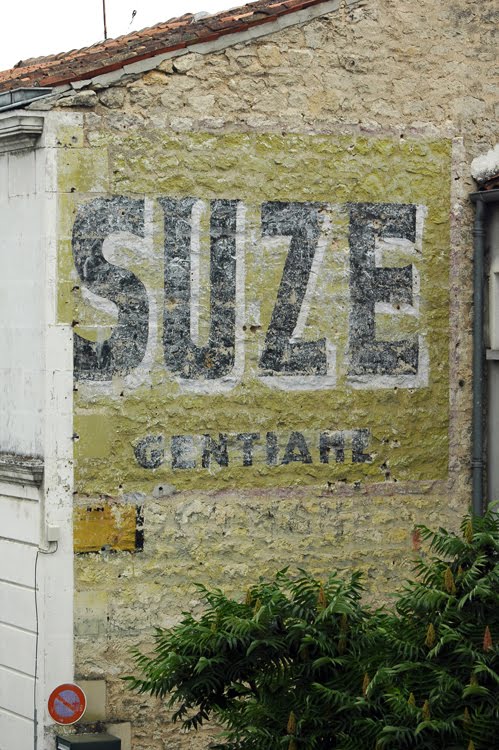
After the Dubonnet sign, and only a few metres away from the Valentine sign is this ad for another aperitif: Suze, with its characteristic yellow background.

Suze
Gentiane

Although the Rousseau, Laurens et Moureaux distillery was founded in 1795 outside Paris in Maison Alfort, it was only in 1895 that Fernand Moureaux decided to create an aperitif that wasn't wine-based. The alternative he came up with, using a Swiss recipe, was gentian roots, both distilled and infused. This Alpine plant, to which extracts of several aromatic plants are added, gives Suze its peculiar bitter taste and yellow colour. After four years of research the new aperitf was launched. Called Suze, either after Moureaux's sister-in-law Suzanne or a Swiss river, it was sold in an easily recognizable bottle designed by Henri Porte. By the turn of the century Suze had become a common sight on the tables of French cafés and in 1912 Picasso immortalized it on his collage 'Glass and Bottle of Suze'. However in a tough aperitif market, Suze needed more than Picasso to strengthen its position. That was why in 1922 Moureaux launched a huge advertising campaign. The aim: to have the name Suze painted in every French village! I don't know whether they succeeded but there are certainly quite a few signs left...
1945 saw a major change: the alcohol level was lowered from thirty-two degrees to sixteen. In 1965 the Suze brand was purchased by Pernod Ricard. More about Suze since then can be found on the company's website. At the bottom of the page is a display of limited-edition bottles designed since 2001 by the likes of Jean-Charles de Castelbajac, Christian Lacroix, Sonia Rykiel or Thierry Mugler among others.

Next

Location: Avenue Aristide Briand, Saintes, Charente-Maritime / Picture taken on: 06/06/2010

St Rahaël and Byrrh, Saintes

Eleven minutes in Saintes, part 6 (Go to part 1, 2, 3, 4, 5, 7, 8, 9)

A little bit further down the road from the second Redondeau sign was a much more interesting wall with three signs, two of which advertised, you've guessed, it... aperitif drinks!

Let's start with the most recent layer, which reads
...ele...
Restaurant
Et Pension [Guesthouse]

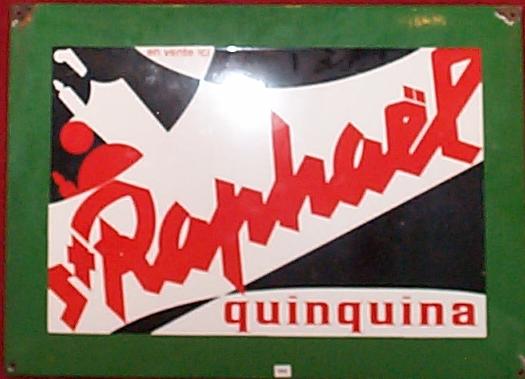
However the most colourful and easily recognizable sign here is for the aperitif St Raphaël. This 1950s design, the work yet again of Charles Loupot, is much bolder than the one from Rigny-Ussé I posted a couple of months ago, and is similar to an enamel sign auctioned some years ago at Drouot.
These large red letters in a white and black background would have caught the attention of passengers on passing trains. Since there is almost no traffic on this street, these were the targets of this sign. Having said that, I used to travel a lot by train between Bordeaux and Saintes as a kid and teenager and I can't say I ever noticed it. Maybe because I always waited until the last minute to pack my stuff or was looking for my grand-pa's car parked by the local railway headquarters across the tracks...
Equally noticeable would have been the earlier sign for Byrrh, in even larger white letters on a red background. Byrrh was invented in 1886 by two itinerant drapers, brothers Pallade and Violet Simon by mixing dry wines from Languedoc-Roussillon and mistelles. To this they added some cinchona and obtained a product that was originally considered to have such invigorating properties that it was only sold by chemists. Its reputation as a health drink ensured its success in the early twentieth century and sales peaked between the two World Wars. However after the Second World War sales of Byrrh declined sharply because of fiscal advantages awarded by the authorities to naturally sweet aperitif wines and of changes in people's tastes. By the 1970s Byrrh, which had remained a family business, was bought by spirits company Cusenier, already part of the Pernod Ricard portfolio.

Next

Location: Rue du Souvenir, Saintes, Charente-Maritime / Picture taken on: 06/06/2010

Les bières de l'Atlantique, Saintes

Eleven minutes in Saintes, part 9 (Go to part 1, 2, 3, 4, 5, 6, 7, 8)

Finally, just down the road from the signs in parts 7 and 8 is this façade on which another drink was being promoted. Like the Byrrh / St Raphäel sign, this one was designed to be seen from passing trains.

Les bières
de Bordeaux
L'Atlantique
sont
supérieures

Whether these beers brewed in Bordeaux were really superior I don't know...
The Brasserie de L'Atlantique (Atlantique Brewery) was founded in 1901. It stood south of the city centre on the Quai de Brienne. The brewery adopted a cockerel as its emblem and its trademark beers were the 'Bière du Coq', a lager, 'Cynthia', a semi-brown ale, 'Le Coq Export', a golden lager, and 'Le Coq Monopole', a pale lager. Other beers on offer included 'Alsacienne Blonde', 'Bière Bock', 'Bière La Cigale', 'Bière Cristal', 'Bière Galacta', 'Bière de Mars', 'Bock Cristal', 'Elfenbein', 'Excelsior', 'Hallerpils', 'Moldovia', 'Monopole', 'Monopole Atlantique', 'Monopole Export', 'Prosit', 'Spalthaller', and 'Thallerburg'. Between 1912 and 1932 under the management of Emile Schirber the brewery increased its regional presence, with warehouses in Périgueux, Brive, Rochefort, Mont-de-Marsan, Bayonne and Angoulème, and took over a small brewery, the Brasserie Fischer et Leppert. In 1966 it was its turn to be taken over, by the Brasserie de la Meuse, a group of twenty breweries disseminated across France, which that very same year merged with the Grandes Brasseries et Malteries de Champigneulles to form the Société Européenne de Brasserie, a group of twenty-three breweries. At the time the SEB was the largest brewing group in Europe but it was a heavy structure, particularly costly to manage, and inadapted to a market in which the demand for small bottles was growing rapidly. As a result in 1970 glassmaker BSN purchased the SEB. Three years later BSN merged with Gervais Danone to give birth to the multinational company now known as Danone.
I haven't been able to find out when the Brasserie de L'Atlantique closed down but the site where it stood was redeveloped in the 1960s or early 1970s when the wholesale market across the road expanded.
You can see some of its labels and posters here, here, and here. More images of beers brewed by the Brasserie de L'Atlantique can be found here (look for 33 Atlantique towards the bottom of the page and click on the different letters in the columns to the right).

If the words are still visible on this façade, the logo of the Brasserie de L'Atlantique has almost completely faded. On the second picture below I have pasted it and rewritten the name of the brewery. The result isn't great but you can compare the two pictures and get an idea of how it would have looked originally.


After so many stops it was time to meet my parents and girfriend by the fishmonger's stall to help them select some seafood and fish for dinner the next day. I wouldn't have been against looking around for a bit longer but that will have to wait until my next visit to Saintes.

Location: Avenue de la Marne, Saintes, Charente-Maritime / Pictures taken on: 06/06/2010

Wednesday, 21 April 2010

Robins' Brewery, Seaford

After Smithers earlier this week, we return to the world of Sussex brewers but this time move from Hurstpierpoint to Seaford. Indeed in this sleepy seaside town stands a building, now occupied by the Lucky House Chinese takeaway, that displays both a ghost sign and a mosaic.

Robins'
Brewery


I haven't been able to find any information on the internet about that particular brewery. However the name Robins appears in connection with several other breweries in Sussex and it could be that a member of the family either established a brewery in Seaford or took over an already existing one.
Born into an empoverished Jewish family from Hove, Ebenezer Robins had become by 1800 an established brewer (the date of 1789 has been suggested regarding the foundation of his original brewery) and he soon began to amass a respectable fortune. In 1830 he became one of the original Brunswick Town Councillors. During the 1830s he purchased several plots of land to build houses for other members of his family and to build a new brewery. Opened in 1840 in Waterloo Street near the Hove - Brighton limit, the Anchor Brewery replaced the original facilities in Western Street. One of his brothers, Usher, also achieved some success in the brewing trade. The companies they set up passed on to their heirs and documents indicate that in 1877 Usher Robins & Co. took control of the East Street Brewery in Horsham before selling it one year later, while in 1889 E. Robins & Son took over the Albion Steam Brewery in Shoreham. Several generations occupied key positions in the business, even after E. Robins & Son Ltd merged with Findlater Mackie & Co in 1929 (the names of both companies were kept). However the Robins seem to have paid a heavy price during the Second World War, with several men not returning from the front. As a result it looks like the family sold its remaining shares in 1946. By 1949 all activity had ceased at the Anchor Brewery.
It seems E. Robins & Son continued trading until 1964 but there is no mention of it after that date. Perhaps it disappeared in the reorganisation process that followed the purchase of George Prentis & Sons Ltd by Findlater Mackie & Co in 1962. The new company, Findlater Prentis, was eventually bought by Whitbread in 1967 and liquidated in 1971.
Could the Seaford brewery be linked to that family? It isn't impossible, but I can't be sure...

Location: High Street, Seaford, East Sussex / Picture taken on: 25/07/2009