Showing posts with label Putney. Show all posts

Monday, 17 December 2012

Undertaker, Putney

The removal of a large billboard earlier this year led to the reemergence of half a ghost sign in Putney.

Unfortunately the other half is still hidden behind a sign for the Clock Clinic, the current occupier of the premises. As a visit to the local library and an online search failed to provide any information about any undertaker on Lower Richmond Road, the name remains a mystery.

...ain
Undertaker

Location: Lower Richmond Road / Pictures taken in July 2012

Tuesday, 9 October 2012

Imperial Typewriter, Putney

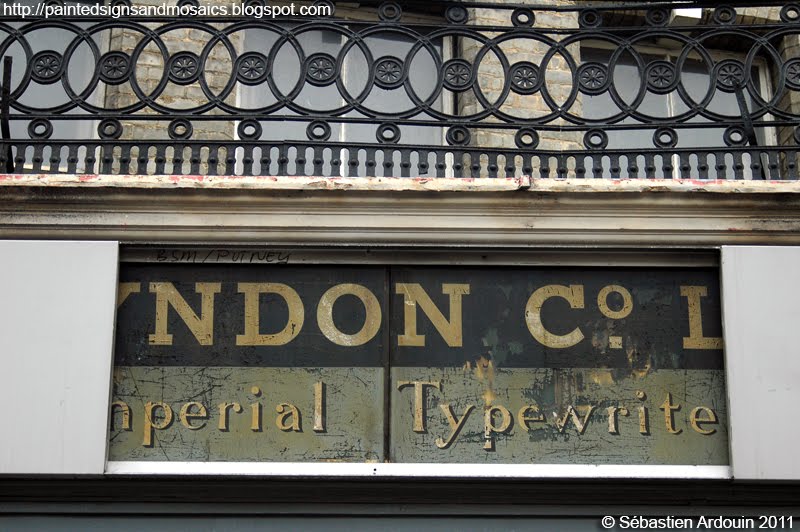
A recent visit to Leeds Castle reminded me of a painted signage for an office furniture shop in Putney. The ghost sign below, painted on wood, could be seen for a few months while the shop was being restored prior to being put on the market. Unfortunately I don't think it was ever fully visible.

The Lyndon Co. Ltd.
Imperial Typewriter

The only mention of The Lyndon Co Ltd at its Putney address I could find dates from 1968. However, given the style of the painted sign, we can assume it had been selling office goods for a few decades. A company of the same name traded until a few years ago in Wandsworth High Street so maybe it had relocated there at some point. As the sign suggests, Lyndon was the Imperial Typewriter Company's local agent.

The Imperial Typewriter Company was established in Leicester in 1908 by Hidalgo Moya, an engineer who had been designing and selling typewriters since 1903. However his earlier models were not without problems and sales remained disappointing. In order to obtain the capital needed to develop a prototype that could conquer the office machine market, he founded Imperial Typewriter. The Imperial Model A was released in 1908 and remained in production until 1915. Other models followed. In 1927, with Imperial Model 50, Imperial Typewriter finally abandoned the three-bank keyboard in favour of the much more popular four-bank one.

In 1932 the company launched its first portable typewriter. This machine, originally developed in partnership with German company Torpedo, was to be called Regent but apparently the success of J. B. Priestley's The Good Companions led to a last minute rethink and after an agreement had been found with the writer, the portable typewriter adopted the name The Good Companion. Priestley was given the first one, while one was sold to Buckingham Palace. As a consequence, Imperial Typewriter was allowed to feature the coat of arms of King George V with the mention "By Royal Appointment" on its machines. The Good Companion, in its seven different designs, remained in production until 1963, making it the most successful portable typwriter at the time.
In 1953 Imperial Typewriter opened a new factory in Hull for its portable machines while the ones for office use continued to be manufactured in Leicester. However by the 1960s the company was facing growing competition and losing ground to cheaper models from the far east and mainland Europe.
In 1966 Imperial Typewriter was acquired by US company Litton Industries through its Royal Typewriter division. Litton kept the Imperial brand for a few years but it disappeared eventually in the 1970s. The Leicester plant closed down in 1974.

I remembered this ghost sign when, while at Leeds Castle, I noticed the Daily Sketch from June 19, 1940, carried on its from page an advert for the Imperial Typewriter Company. Then, in another room, a model of The Good Companion sat on a desk.

Location: Upper Richmond Road / Pictures taken in January 2011 and October 2012

Thursday, 24 November 2011

Tailor and habit maker, Putney

The tailor and habit maker may be long gone but the attractive if rather sober mosaic survives to this day. Somehow the overall shape reminds me of the patterns used by tailors to create suits and other garments.


Location: Upper Richmond Road / Picture taken on: 15/08/2008

Wednesday, 8 June 2011

Hair cutting and shaving saloon, Putney

A barber and hairdresser replaced a seller of different goods to owners of horse carriages, who previously had taken over this shop from an unknown tradesman. All are long gone but they left us with some ghost signs.


The first signs can be seen above the entrance. This space was used by the three successive owners. I only managed to decipher completely the new one. It reads
Hair
Cutting
And
Shaving
Saloon

The older ghost signs are much trickier to read as they were more elaborate, with some words written diagonally and undulating. The only ones I can identify are
Basket
...nks [Trunks?]
Other letters and a number can be seen here and there but I can't make any sense of them.

At the back of the shop was another sign, designed to be seen by people coming from Putney High Street. This wall seems to have been used only by two businesses (the new one is on the left, the old one on the right).

Hair
Cutting
And
Shaving
Saloon
Ford
Basket
Harness
&
Trunk
...

Location: Lacy Road / Pictures taken on: 22/05/2008

Monday, 11 April 2011

Tarrant, Putney

After taking a picture of the ghost sign below I headed to the library in Putney to see if they had any information about the business advertised on this wall at the back of the High Street. All I found was a picture taken c 1905 of a dairy of the same name on Lower Richmond Road but nothing about Tarrant, the juvenile outfitter.
This sign has badly faded and it looks as if there could have been more written on that wall than what I've been able to decipher.

Tarrant
Juvenile
Outfitter

Location: Chelverton Road / Picture taken on: 25/03/2011

Friday, 19 February 2010

H. Roffe & Sons, Putney

For many small businesses around the country, a simple sign with the name and nature of the business in a basic typeface painted on the premises was enough to signal their presence to potential local customers. Not significant enough to feature in local history books, such a sign is often the only trace they have left.

H. Roffe & Sons
Contractors

Location: Lacy Road / Picture taken on: 18/08/2008

Tuesday, 18 August 2009

Baths, Putney

Those of you who ventured on Putney High Street heading north towards the bridge have certainly noticed the modern painted sign for Spanish restaurant La Mancha (just in case you wondered, the food is rather average, so is the service, and the place can be very loud).


But how many have spotted that this modern sign covers almost entirely a much older one? Nowadays, the only visible words are: "...ic Baths." A look at old pictures of the High Street confirmed what I thought: it was for the local public baths.


So here we have a sign which, looking at what is left of it, was neither beautifully-designed nor eye-catching, but which reveals some aspect of our local history.

Peter Thomas published a fascinating article in the Winter 1986 issue of The Wandsworth Historian about William Bishop and the Putney Public Baths and this is where most of what follows comes from.
The story began in 1883, when the vestry, concerned by the lack of access to running water of the vast majority of inhabitants around Putney, put forward a proposal for the construction of public baths to be financed by taxpayers. However Putney taxpayers, whose meanness was apparently well-known, rejected the proposal. A few months later, local entrepreneur William Bishop, who had made a small fortune in the building trade, stepped in and announced he would build public baths as a commercial venture. Designed by architects Lee Bros & Pain, they opened on Saturday June 5, 1886 at the corner of Putney Bridge Road and Burstock Road. The baths, which were said to have been rather luxurious, could accomodate between 200 and 300 people at any given time. They included a large swimming pool, private baths, as well as Turkish baths. During the winter months the main swimming pool was boarded over and converted into the "Cromwell Hall", where banquets, concerts, public meetings, music halls, and other kinds of performances could be organized. A strict segregation between genders existed in the public baths, with separate entrances for women and men and an alternance of women's days and men's days. Class was the other dividing line. When they opened in 1868, prices were 9 d. for first class, and 6 d. for second class. Private baths cost 1 s. first class, and 6 d. second class. These were relatively high prices for the time, and were certainly beyond the means of those the baths had originally been intended for (in most public baths across London run by local parishes or metropolitan boroughs, a hot bath and the use of a towel cost as little as one penny or two pence). Additionally under pressure from the Church the baths closed on Sunday, the only day when working classes would have had enough time to go for a swim.
Attendance probably never reached the levels expected and consequently the Putney public baths were certainly never a financial success. They were demolished in September 1986 after years of neglect.

Putney High Street / Picture taken on: 15/08/2008

Tuesday, 28 July 2009

Peterkin's custard, Battersea, and Flins & Sons, Putney

Over the past couple of years I have been taking hundreds of pictures of painted signs and mosaics, mostly in London and across the southeast. Whether they are highly elaborate or very simple, relatively well-preserved or have almost completely faded by now, they provide an insight into our social history and past commercial practices.


I thought I should start this blog with the first painted sign I spotted in London about 10 years ago, and one I look at every time I take a bus between the Putney area and Clapham Junction. With its smiling boy, this is definitely one of my favourite ghost signs!


Peterkin's
Custard
Self-Raising Flour
Corn Flour
Can Be Obtained Here

"Little Peter" (the suffix -kin meaning little, like -kijn or -ken in Dutch or -chen in German) was the face of a product launched by Joseph Arthur Rank after he joined his father's milling business in 1905 at the age of 17. Apparently Peterkin's Self-Raising Flour was not a big success but it was still being sold by 1926. That year "a grocer was summoned at Marylebone Police Court by the Hampstead Borough Council for having sold to the prejudice of the purchaser, egg custard not of the nature, substance and quality demanded." You can read more about the case here: http://www.rsc.org/publishing/journals/AN/article.asp?doi=an9265100185

The case was dismissed on the grounds that there were no standard for custard powder and that given the price of Peterkin's (1 and 1/2 d. for a pint packet), customers should not expect too much of it... What a surprise!


Location: St John's Hill / Both pictures taken on: 05/03/2008

I always thought it was a bit of a miracle this ghost sign was still with us, given its position on a major thoroughfare, and in such a good state.


Although the following signs are not as eye-catching, I include them on this first post simply because they are the nearest ones to where I live (unless another one is hiding right under my nose and I have managed to miss it so far!). As it is often the case the same wall was used by different businesses to advertise their products or services and the texts overlap.

Below is the right-hand side of the wall:

A Flins [?]
And
Sons
Everything
In
Woodwork
Advertising Space
Riverside Works
To Let
...al Motor Body
Con... Dept

Having stumbled on this sign, it is easy to walk away hoping to find another one further down the road... Yet there are clearly three texts on this part of the wall and a close look reveals that the last two lines start on the left, on the part of the wall that appears empty at first sight. I have enhanced slightly the picture below to make whatever is left of the sign come out. The most legible part is next to the little window.

Engineering
... Work ...
Cars Lodged in Garage
Phone Putney 2385

Location: Ruvigny Gardens / Both pictures taken on: 30/04/2008