Showing posts with label Germany. Show all posts

Wednesday, 4 November 2015

Otto Dick, Bützow

A not-so-cheerful ghost sign spotted in a street of Bützow, a small town in northern Germany. I wonder whether this house survived the tornado (F3 on the Fujita scale) that devastated the town on May 5, 2015, one year after I took these photos.


Särge          Otto Dick          Möbel
Tischlermeister


Otto Dick
Tischlermeister
[Master Carpenter]


Särge
[Coffins]


Möbel
[Furniture]

Location: Mantzelstraße, Bützow, Mecklenburg-Vorpommern

Monday, 2 November 2015

August Haackert, Gustrow

A couple of warehouses are still standing near Güstrow train station, between the aptly-named Speicherstraße (Warehouses Street) and the railway tracks 


One of these belonged to coal merchant August Haackert. The building dates probably from the late 19th or early 20th century and was used to store coal and building materials. Following the fall of the Wall, it was used briefly to store cereals.


Aug. Haackert
Kohlen     Baustoffe     Eisen
[Coal     Building Materials     Iron]


After years of decay, the Haackert warehouse, which is listed, has been recently restored and houses nowadays the "Physiotherapie im Speicher" practice.


Since these photos were taken the windows and the roof have been replaced and the ghost sign given a new coat of paint.

Location: off Speicherstraße, Güstrow, Mecklenburg-Vorpommern

Thursday, 24 September 2015

Fleischerei, Pirna

A very basic sign for a butcher's spotted in the town of Pirna, south east of Dresden.


Fleischerei


Location: Bahnhofstraße, Pirna, Sachsen

Wednesday, 23 September 2015

Schuhmacherei, Pirna

Before these premises were taken over by shoemaker Kun, there was a shop selling spirits and cigars (the name was painted above the windows but only a few letters can still be seen).


Schuhmacherei Kun
Spirituosen
Cigarren


Spirituosen


Cigarren

Location: Obere Burgstraße, Pirna, Sachsen

Wednesday, 14 August 2013

Bäckerei, Hohnstein

Dominated by its castle, the little town of Hohnstein in Saxon Switzerland has a couple of ghost signs, including the one below for a former bakery.

Bäckerei [Bakery]

Location: Obere Straße, Hohnstein, Sachsen / Picture taken in October 2011

Tuesday, 26 March 2013

Blumen und Sämereien, Bautzen

Compared to the ghost signs for Kutschke the master roofer and Ullrich the tailor also found in Bautzen, in eastern Saxony, the one for this flower and seed shop is extremely simple. It is also much more recent as it was probably painted in the 1970s or 1980s.

Blumen u. Sämereien
[Flowers & Seeds]
Location: Rosenstraße, Bautzen, Sachsen / Pictures taken in October 2011

Thursday, 20 December 2012

Nähmaschienen, Stralsund

While many ghost signs are found on not-so-well maintained or derelict buildings, it is not uncommon in Germany to find some on recently restored properties (even if more often than not ghost signs disappear completely when a restoration is undertaken, as happened with the optician sign in Eibenstock last year). The combination of new roughcast and fading paint may look odd at first sight but the presence of a ghost sign definitely adds a nice touch to what is often a rather plain façade. Are these ghost signs in some way legally protected? Unless a building is listed or is in the equivalent of a conservation area, I would not think so. I'd rather think they are preserved because the buildings' owners are attached to them. As properties are often passed from one generation to the next, these ghost signs are very much part of the history of a family. Some may also consider they add some character, and value, to their property.

Whatever the reason was, visitors to the Hanseatic city of Stralsund on the Baltic Sea can still notice that a shop that sold sewing machines once stood at the corner of Papenstraße and Filterstraße.

Nähmaschienen (Sewing Machines]

The spelling Maschiene, instead of the correct Maschine, is interesting. The word was borrowed in the 17th century from the French, machine, and Germanised with the addition of a 's' before the 'c'. By then it referred to engines used during a military siege. But where does the additional 'e' come from? One possibility is that, in parts of what would become Germany, it was inserted so the spelling corresponded to the correct pronounciation (with a long 'i'). Another, more fanciful explanation is that the word lost its purely military sense and became widely used when steam locomotives (Dampfmaschinen) appeared. As these machines go on rails (Schienen), some people erroneously combined the two into Maschienen.

Finally, this was not the only ghost sign there. Traces of an earlier one can still be seen but it is impossible to decipher it.

Location: Papenstraße, Stralsund, Mecklenburg-Vorpommern / Picture taken in May 2009

Tuesday, 23 October 2012

Musikwaren, Stralsund

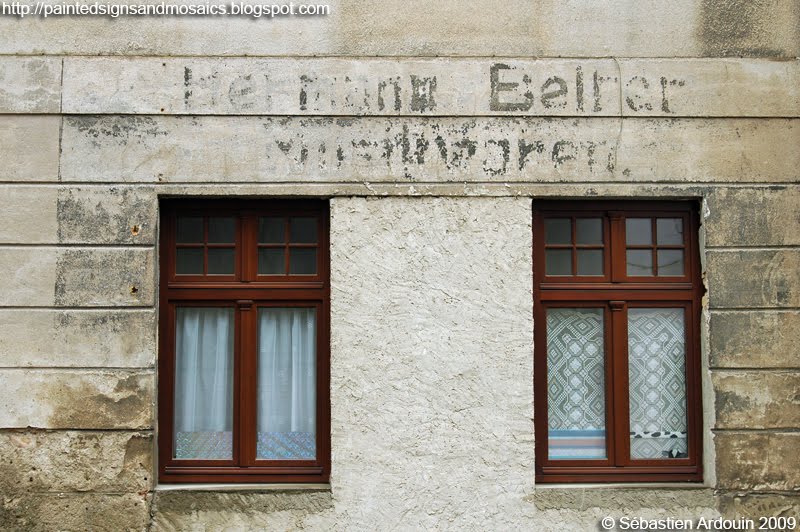
In the absence of any document it is impossible to tell when this ghost sign for Hermann Belter's music shop was painted.

Hermann Belter
Musikwaren

The word "Musikwaren" means literally "music articles."

Location: Wasserstraße, Stralsund, Mecklenburg-Vorpommern / Picture taken in May 2009

Friday, 17 August 2012

Hotel Roßthaler Hof, and Julius Krümling, Dresden

A day in Dresden that had begun with the colourful ghost sign for the garages of Hotel Burgberg ended with another one, this time on the façade of a derelict building facing the railway tracks near Dresden Mitte station.

According to the list established by the Landesamt für Denkmalpflege Sachsen (Saxony's Office for the Preservation of Momuments and Historic Buildings) the building at Roßthaler Straße 1 dates from around 1870. Back then this residential block was located on the northern bank of the Weißeritz, a short tributary of the Elbe which ran through the Wilsdruffer Vorstadt neighbourhood, to the north west of the inner city.

However at the end of the 19th century, the authorities in Dresden decided to modify the lower course of the Weißeritz as the river was prone to flood. Therefore when the railway tracks between Dresden Hauptbahnhof (Dresden Central station) on the left bank of the Elbe and Dresden-Neustadt station on the opposite bank were relaid, it was diverted further north by means of a canal in order to avoid further floodings and damage to the railway arches. The earth excavated during the works was used to fill in the river bed. The current Marienbrücke of the railway stands roughly at the former confluence of the Weißeritz and the Elbe.

Following these works the street took its current appearance and in 1903 was named Roßthaler, after Roßthal, by then a small village 5 km southwest of Dresden city centre. I don't know when this residential block was transformed into a hotel but if the Hotel Roßhaler Hof was the first one there it can be assumed this was after 1903.

Indeed there is no information on the web about this hotel. There may be something in the book Die Wilsdruffer Vorstadt-Seevorstadt West, part of the excellent series Aus der Geschichte eines Dresdner Stadtteils, but it was unavailable last time I was in Dresden.

Unfortunately the building has been empty for two decades at least (a picture taken in 1992 shows it was already abandoned) and its future is uncertain. Indeed even though the former Roßthaler Hof and the buildings next door are listed, in 2006 surveyors recommended they be demolished on the grounds that they were structurally unsound and the cost of restoring them would be far too high. Nothing was done straight away but in 2010 in spite of the concerns of the Linke (The Left) and the Bündnis 90/Die Grünen (Alliance '90/The Greens) groups on the council about the future of the Roßthaler Straße buildings, the mayor confirmed they would be demolished. This was not the end though as Bündnis 90/Die Grünen challenged the measure and this bought time for a private investor to be found who agreed to finance the restoration of the buildings at Roßthaler Straße 1 and 2 (number 2 is on the left on the pictures above) and Schweriner Straße 63 (on the right. The entrance is just round the corner, hence the different street address).

Julius Krümling
Fluss- Kanal- Schiffahrts- Reederei
[lit. River and Canal Navigation Shipping Company]

Hotel Roßthaler Hof Hotel

Apart from those for the Hotel Roßthaler Hof, ghost signs for the shipping company Julius Krümling can also be seen on the façade. The company was founded in Magdeburg in September 1914, shortly after the beginning of the First World War, by Prussian sea captain Julius Krümling. It became rapidly an important shipping company, with offices in Hamburg, Stettin (present-day Szczecin, in Poland), Danzig (present-day Gdańsk, in Poland), Berlin, Breslau (present-day Wrocław, in Poland), Dresden, Hannover, Duisburg-Ruhrort and Rotterdam. It operated a fleet of steamships (16 at least), motor boats, tugboats, and barges that carried goods not only along the Elbe, the Rhine and the canals of Germany, the Netherlands, and Belgium but also towards the harbours of East Prussia and of other countries surrounding the Baltic Sea.
In 1925 the name of the company was changed from Julius Krümling to Reederei A. G. (vormals Julius Krümling). The deep economic crisis that hit Germany in the immediate aftermath of the 1929 Wall Street crash dealt it a fatal blow. It was declared bankrupt in 1930 and its properties were seized.

This ghost sign was certainly painted not long after Julius Krümling was registered in 1914. Did the company have its offices while the hotel was open? Or did it precede or came after the hotel?

Click on the pictures below for an enlarged version.

Ghost signs can also be found above the ground floor windows and entrance. This part was painted on a couple of occasions. Unfortunately I haven't managed to decipher everything.
The first picture below shows the complete façade, reconstituted by stitching seven pictures together. The following ones show parts of it. Click on each to enlarge.

Gaststätte Roßthaler Hof ... ... Hausschlachterei
[Roßthal Court Inn ... ... Butcher's]

Apart from the palimpsest that includes Hausschlachterei (Butcher's) above the door, traces of other painted signs can be seen by the entrance to the building but only the two on the left pillar can still be read. As they overlap, one was painted before the other but it is hard to tell which one came first.

Hotel
Tel. 2582.
Fremdenglocke
[Doorbell]

The word Fremdenglocke is mostly found in texts from the 19th and early 20th centuries (and obviously on this ghost sign!) and could be translated either as doorbell or visitors' bell.

Finally two ghost signs can be read between some of the windows. As vegetation grows in front of the second one, two pictures were needed to get it all.

Fremden-
Zimmer
[Bedrooms]
Garten-
[Garden]

Restaurant


This last ghots sign looks remarkably recent, or at least less old than all the others. It may well date from the GDR period.

Next time I'll be in Dresden I'll try to go and check whether the building that housed the offices of Julius Krümling and the Hotel Roßthaler Hof is still standing and if the restoration work supposed to be carried out by the private investor has been sympathetic to the ghost signs on the façade. If not all that would be left of them would be some pictures.

Location: Roßthaler Straße, Dresden, Sachsen / Pictures taken in October 2011

Tuesday, 19 June 2012

Hotel Burgberg-Garagen, Dresden

I first noticed this ghost sign near Dresden's Blaues Wunder (the common name of the 1893 Loschwitz Bridge) while being driven to Bautzen. Since I wanted to take a few photos in the area I didn't ask my mother-in-law to make an emergency stop on that occasion. Two days later I was back, and just as I alighted from the tram, the rain started. Bad luck.

The design of this ghost sign for the garages of the Burgberg Hotel is not amazing but I just love the red letters on the fading pastel orange of the façade. Great colours!


Hotel Burgberg-Garagen.
<--- Einfarht hier [Entrance here]

The Burgberg Hotel was located on the wooded hill behind the garages. The lane leading to the hotel was rather steep and narrow and that may explain why cars were left in a building by the main road. A path must have linked the two and it is possible the hotel operated a shuttle for its patrons.

The hotel and its restaurant were built by wine grower Gottfried Bormann in 1853 and enlarged six years later. In the late 19th century Loschwitz became extremely popular and at weekends people flocked to the hills dominating the valley of the River Elbe. The Burgberg was famous for its gastronomy and its restaurant, with its terrasse overlooking the river and the Blaues Wunder, was very often full.
The hotel was completely rebuilt in 1926-1927. A ballroom was added to the delight of visitors.

Sadly the hotel burnt down during the bombing of Dresden between 13 and 15 February 1945. If the city centre bore the brunt of the bombing, with more than 90% of the buildings reduced to rubbles, the suburbs were also hit. Lack of resources and the new political situation after the war meant the Burgberg Hotel was never rebuilt. In 1967 the few walls still standing were pulled down.
Nowadays trees have reclaimed the area and few traces of the hotel remain. The building that housed the garages is one of them.


Zimmer Frei [Rooms Available]
Hotel Burgberg
<----

The passageway to the left of the building leads to a courtyard, with six garages arranged on two sides. This may sound rather small but, at weekends at least, most patrons would have arrived by public transport, taking either a tram or one of the popular steamboats that cruised along the Elbe.

Location: Grundstraße, Loschwitz, Dresden, Sachsen / All pitures taken in October 2011

Friday, 13 April 2012

Wagenbau-Anstalt, Dresden

Until the 1990s, many ghost signs could be seen along the streets of the Äussere Neustadt neighbourhood of Dresden, usually by or above the doorways of buildings erected during the second half of the 19th century or the early 20th century. Unfortunately many disappeared when, following the reunification of Germany, many buildings were either restored or demolished. One exception is the ghost sign for Theodor Richter, which still spans the entrance of his former carriage works. The building dates from 1895 and given the style of the sign I would assume Richter moved there immediately or soon afterwards. I haven't any information about this company though.

The books of the series Aus der Geschichte eines Dresdner Stadtteils, about the history, social and cultural life, and economy of the different districts of Dresden (16 volumes so far), include some pictures of ghost signs taken in the 1990s and early 2000s, many of which have now disappeared. Each volume is well-illustrated, and looking at the old black and white pictures, one rapidly realizes that parts of the town were absolutely covered with painted signs.

Wagenbau-Anstalt von Theodor Richter
[Theodor Richter's Carriage Works]


Location: Böhmische Straße, Dresden, Sachsen / Pictures taken in December 2009

Tuesday, 27 March 2012

Konsum, Stralsund

Even though this ghost sign is quite damaged, it is still possible to recognize that this building, one of several awaiting restoration in the northern German city of Stralsund, once housed a Konsum, a shop of the East German Union of Consumers' Cooperatives (Konsumgenossenschaft).
The origins of Konsum go back to 1850 when the first German consumer cooperative was founded by workers in Eilenburg near Leipzig. The number of cooperatives and their membership increased throughout the second half of the 19th century and by 1918 they totalled 1,400 with more than four million members. Membership peaked in the 1920s and early 1930s. However following Hitler's accession to power in 1933 the Nazi government actively discouraged consumer cooperatives before eventually dissolving them and confiscating their properties.
Cooperatives re-emerged after the Second World War. In the eastern part of the country, they were reorganized by SMAD, the Soviet Military Administration in Germany, who returned their confiscated properties and encouraged membership. By the end of 1947, 1.8 m East Germans had joined, twice as many as in 1932 (number for the Länder that would form the GDR). By the 1980s the figure reached 4.5 m members. Under the aegis of the East German authorities, the Union of Consumers' Cooperatives became a semi-state institution in charge of trade, together with the state-owned Handelsorganisation (HO - Trade Organisation). For a few years cooperative outlets operated side by side with private traders but by 1953 the government actively discriminated in favour of Konsum shops. Thus their number expanded considerably, especially in rural areas where they were often the only shop around. Three years later, the government introduced commission trade, whereby private shopkeepers were encouraged to sell HO and Konsum goods. As a result, HO and Konsum handled the vast majority of the retail trade in the GDR.
Many Konsum shops, in particular in rural areas, predated the Second World War. These were small, lacklustre units. Yet in the 1970s new Konsum shops and department stores started to appear in the larger cities. In the Hanseatic city of Stralsund several shops were enlarged and modernised, although this trend may have bypassed the small shop below.
In the early 1980s, Konsum was divided territorially and functionally into 198 retail enterprises but this did not affect the brand. Following the re-unification of Germany in 1990, these were regrouped into 55 cooperatives before being privatised by the Treuhandanstalt. Nowadays several cooperatives still operate in the eastern Länder and use the name Konsum for their shops.

Konsum

Location: Frankenstraße, Stralsund, Mecklenburg-Vorpommern / Picture taken in May 2009

Wednesday, 22 February 2012

Uniformen Ullrich, Bautzen

Here is a ghost sign that may well disappear pretty soon. Indeed I doubt anybody would restore the house where Herr Ullrich once cut and sewed uniforms. It will most certainly be pulled down and a new building erected in its place.

This is really a typical German painted sign: sober, written with a blackletter typeface and with the long s of Schneidermeister in the shape of a f.

Uniformen
Ullrich
Schneidermeister [Tailor]

Location: Töpferstraße, Bautzen, Sachsen / Pictures taken in October 2011

Wednesday, 25 January 2012

Schuhmacher, Aue

Amazingly the façade with its ghost sign was left untouched when this house overlooking the railway tracks in the small industrial town of Aue in the Erzgebirge district of Saxony was renovated.


I doubt that shoes and other leather goods are still being made inside.
Did this ghost sign survive because no work was needed on the façade? Or was it a conscious decision by the owners? After all maybe they wanted to preserve something they considered to be part of their family's history?

Leder - Schuhmacher - Bedarfsartikel

A different typeface, which looks older, was used for 'Leder' ('Leather'). Was it to emphasize that both shoes and other goods were made of leather? Or did 'Schumacher - Bedarfsartikel' replace an earlier sign and 'Leder' was kept to save on paint?

Location: Pfarrstraße, Aue, Sachsen / Pictures taken in December 2009

Thursday, 13 October 2011

E. F. Kutschke, Bautzen

Bautzen, in eastern Saxony, is well-known for its medieval and baroque architecture. If most buildings in the historic centre have been nicely restored, some façades in the surrounding parts of the city have been left untouched and a couple still display the names and trades of the people who lived and traded there.

E. F. Kutschke Dachdeckermeister
[E. F. Kutschke Master Roofer]

Actually there are two ghost signs on this narrow space between the ground and first floor windows. Both advertised a Dachdeckermeister, the original one being more towards the right. Not enough can be seen to be able to identify the full name but the few letters that can be spotted don't match those of E. F. Kutschke.


Location: Rosenstraße, Bautzen, Sachsen / Pictures taken on: 08/10/2011