Both signs side by side
Location: Sankhu, Nepal
A record of painted adverts and doorstep mosaics from Britain, France, Germany and other parts of the world, and the story behind some of them.
C. W. Lindsay & Co was a piano, phonograph, and sheet music retailer. The company was founded by Charles William Lindsay in 1877.
In 1883 Lindsay became the agent for piano manufacturer Heintzman & Co from Toronto. This explains why the name of that firm was painted at the back of the seven-storey building built for C. W. Lindsay & Co. on Rue Sainte-Catherine Ouest shortly after it became a limited company in 1902. The mention 'Home furnishings' may have been painted later, possible after C. W. Lindsay & Co moved out of the building.
Two different ghost signs with the company's name can be seen from Rue Sainte-Catherine Ouest.
The original one read "C. W. Lindsay" (there may have been more). The extra large letters covered the whole side of the building. However it became obscured when new skyscrapers were erected and the company had a smaller but much more visible sign painted in the upper right corner of the wall.
Lindsay's initials, part of the original sign, can be seen from Square Dorchester.
More information about C. W. Lindsay & Co can be found here.
Location: Rue Sainte-Catherine Ouest, Montréal
For more than a century R. F. Stevens manufactured and restored both harmoniums and reed (also known as American) organs. The company also made reed pans and bellows for amateurs or other builders. While many organ manufacturers were rather small (there were over 200 reed organ builders in London alone in the late 19th and early 20th centuries), R. F. Stevens was one of the largest companies in its field, with up to 50 employees. It also offered more portable organ styles than any other company, not only in Britain but certainly in the world. However high numbers do not guarantee quality and R. F. Stevens's organs did not always compare well with those of its competitors, musically and above all aesthetically.
In spite of this R. F. Stevens's portable organs were particularly popular and the company counted amongst its customers the Salvation Army, the prison service and the armed forces. Indeed all Royal Navy vessels had to have an organ on board for playing hymns on Sunday and to entertain the troops from time to time. Portable organs would also have been used to celebrate mass near the front line whenever possible. Thanks to these contracts, R. F. Stevens did remarkably well during both World Wars.
R. F. Stevens managed to remain in business long after most organ manufacturers had closed down. However, due to a lack of demand, production ceased in 1966. The company continued to carry out restoration work but its financial situation deteriorated. In late 1978 it appointed a liquidator and in 1980 R. F. Stevens Ltd officially closed down.
Part of the ghost sign disappeared when the house next door was built but it is easy to reconstitute the missing part.
Location: Leighton Place / Pictures taken in July 2013
The style of this ghost sign is reminiscent of others painted in the late 19th or early 20th century but who, between Dawson and Everett, was behind it is impossible to tell.
Was W. H. Everett related to the Everett who owned the drapery and millinery store on St James's Street, Walthamstow?
Location: High Street / Picture taken in February 2010
If you missed the signs, you can visit the appropriate posts (links above) or simply look at the pictures below.
Location: Percy Road / Pictures taken in July 2009
The easiest ghost sign to read advertised Gillette razor blades. This is one of many found across the capital. The letters were once painted off-white and the background may well have been blue.
The other ghost sign predated the Gillette one. It promoted the Daily Mail, the conservative newspaper first published in May 1896.
| British Made Razor Blades |
The building was designed in 1904 by Treadwell and Martin in a free Jacobethan - late Gothic style typical of the partnership. With its elaborate stone façade, this is not the kind of building where one would expect some adverts to be painted on!
Location: Whitehall / Pictures taken in July 2013
For twenty years or so the Royal's programme combined epic and musical Hindi films with martial art movies from Hong Kong, war movies from the Philippines with cowboys and Indians films from the US. However the Royal, like the three other cinemas of Kampot, shut its doors when the Khmer Rouge seized the town in April 1974. The Khmer Rouge regime fell in 1979 after Vietnam invaded Cambodia but the cinema remained shut for several more years as the country became engulfed in a dramatic war between the occupying Vietnamese army and several resistance movements.
The Royal Cinema reopened in 1984 but closed down a few months later in 1986. It was then used to store water containers. However its story does not end there. In 2009 the Royal Cinema was "rediscovered" by US filmmaker and CamboFest founder/co-organizer Jason Rosette. The same year the family who lives within its walls agreed to allow the 3rd CamboFest Film and Video Festival to take place at the historic venue. Sadly it seems nothing has been shown since then, even if the rumour of a possible reopening of the Royal can sometimes be heard.
After 60 years of troubled history, the name of the cinema, in Khmer, has almost disappeared. I am not absolutely sure but I think it says "រាជរោងកុន".
More traces of painted signs can be seen on the formerly green panel to the left of the entrance.
Location: Kampot / Pictures taken in December 2011
Even though this fair held every year around Ascension Day became 'international' only in 1921, its origins go back to 1214, the year John, King of England and Duke of Aquitaine, granted the city the power to organize a wine fair. This privilege was confirmed and extended by successive rulers, be they English or French. The fair, which had been taking place traditionally in the medieval part of the city, was held between 1853 and 1968 on Place des Quinconces, at 12 hectares one of the largest city squares in Europe. However in the 1960s, as part of the modernisation plans of the city designed by the team of mayor Jacques Chaban-Delmas, the decision was taken to transfer the fair to Bordeaux-Lac, an area seven kilometres to the north of the city centre. The move was quite controversial at the time but it made it possible to increase the size of the fair and to accomodate the growing number of visitors coming by car. In 1969 the Foire Internationale de Bordeaux opened in the brand new hall of the Parc des Expositions. When it opened, this impressive building, 847 m long and with a surface area of 50,400 square metres, was the largest exhibition hall in Europe. Nowadays the international fair is only one of many events that take place throughout the year in the Parc des Expositions.

Was this sign painted before or after the move to Bordeaux-Lac? This is hard to say but should it have been painted in 1969 or later, one might have expected a bolder design, matching the modern image projected by the design of the new exhibition hall.
Of the earlier ghost sign written with very high letters, only a few of these can been seen in the lower part of the wall. The upper part of the word was covered by "Bordeaux" and, to make things more difficult, part of it disappeared when a small window was opened through the wall.

This wall was rented by Avenir Publicité, one of France's leading advertising agencies.
Location: D 137, lieu-dit Roubisque, Saint-Aubin-de-Blaye, Gironde / Pictures taken in May 2012
Still, thanks to some documents available online, it appears that in the 1920s (and certainly before) this was Albert Crick's bookshop and lending library. Indeed, in 1920, several acrimonious letters were exchanged between A. Crick and an anonymous contributor in the pages of The Publishers' Circular and Booksellers' Record of British and Foreign Literature regarding financial aspects of the bookselling business, and in particular the generation of profit.
Copies from 1937 of the same trade journal also show that by then Albert Crick also owned Crick's Library at 11a, Swains Lane. Notices published that year indicate he was selling ex-library books withdrawn from circulation. His main address remained 80, Dartmouth Park Hill though.
This second shop was still open in 1950 according to Clegg's International Directory of the World's Book Trade but there is no mention of it after that date. As for the original Crick's Corner, it is last mentioned in 1937.
Location: Bickerton Road / Pictures taken in November 2012
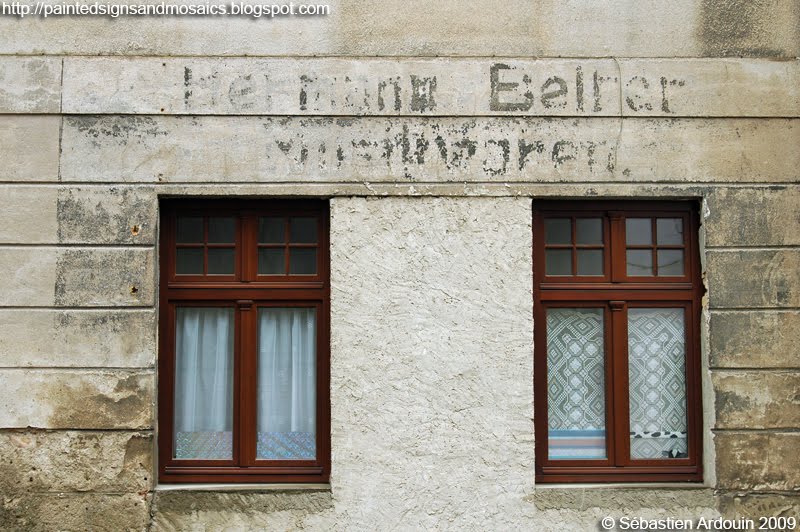
The word "Musikwaren" means literally "music articles."
Location: Wasserstraße, Stralsund, Mecklenburg-Vorpommern / Picture taken in May 2009
For more on this ghost sign (actually ghost signs since this is a real palimpsest), including what was written, please visit the original Kay's Motors post.
Location: Norwood High Street / Picture taken in August 2012
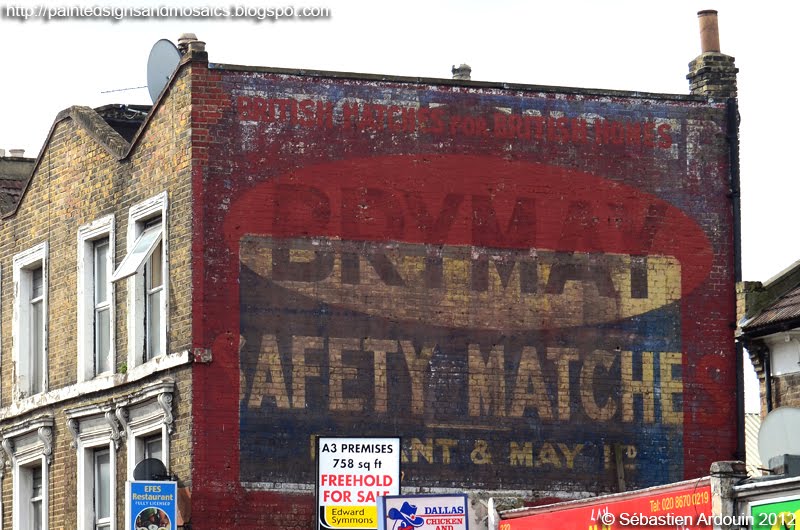
The blue and yellow colours are characteristics of Brymay's signs but the wording is slightly different from that of the better-known ghost sign from New Cross.
The Brymay sign was painted over an earlier one for the Westminster Gazette. For some information about this Liberal newspaper, please see the earlier post about the Criterion, Westminster Gazette, and Gillette ghost sign in Stoke Newington.
Location: Norwood Road / Pictures taken in March 2010 and August 2012
The particular style of the central part of this ghost sign suggests it was painted in the first couple of decades of the 20th century if not slightly earlier. Some letters are reminiscent of those of the vannerie ghost sign in Cognac (15th picture).
Actually 'Salle de danse and billard' was painted over two earlier signs. The original one read:
The shadows made strange patterns on the façade that day.
Location: Rue Nationale, Saint-André-de-Cubzac, Gironde / Pictures taken in May 2012
However these three ghost signs overlap and if two are easy to identify, the third one is trickier - but not impossible after a closer look.
Could anything else have been written with 'Royan'? I think so but I am not sure. Maybe the name of the popular seaside town by the mouth of the Gironde estuary about 100 km from Saint-André-de-Cubzac was enough to attract visitors?
Below, in blue, is the name of France's leading beer brand: Kronenbourg (commonly known as 'Kro') with the slogan "Le grand nom des bières d'Alsace" ("The famous name among Alsace beers"). The brewery was founded in 1664 by Geronimus Hatt in Strasbourg. Being close to the River Ill, it was flooded on several occasions. In 1850 Frédéric-Guillaume Hatt relocated it to higher grounds in Cronenbourg, just to the northwest of Strasbourg city centre. The site also had the advantage of being near railway tracks and from 1857, weekly first and then daily beer trains ran between the brewery and Paris. The beer known today as Kronenbourg was first brewed in 1922. That year the Hatt family bought the famous restaurant Grand Tigre and launched a new beer, Tigre Bock, to celebrate this acquisition. In 1947 Jérôme Hatt changed its name to Kronenbourg. Sold in returnable 33cl bottles, it was an immediate success not only in France but in other European countries as well. In 1970 the family brewery was bought by BSN (nowadays Groupe Danone). Sixteen years later BSN merged its two brewing concerns, Kronenbourg and Européenne de Brasseries (Kanterbräu), to create Brasseries Kronenbourg.
In 2000 BSN sold the company to Scottish and Newcastle at a difficult time. By the turn of the 21st century sales of Kronenbourg were dropping sharply indeed. If 10 m hl were brewed in 1999, by 2007 the figure was down to 7 m hl. In that context the new owners decided to concentrate the production at the Obernai brewery opened in 1969 and disposed of other production sites. In 2006 all activity ceased at the Cronenbourg site and within a few months most of the buildings were demolished. In 2008 Scottish and Newcastle sold Kronenbourg to Danish brewers Carlsberg.
The most visible part of the third ghost sign is the word 'pellicule' (film) in a rectangular frame. A closer look shows 'Royan' hides the name of the company advertised there: Altipan Lumière. Founded by cinema pioneers Auguste and Louis Lumière, it manufactured photography equipment. In the 1960s it was taken over by Ilford Photo.
Location: Rue Nationale, Saint-André-de-Cubzac, Gironde / Pictures taken in May 2012
This building was originally a bakery, as advertised high up on the gable.

To find out more about hygienic bakeries, please check these earlier posts about Hygienic Bakeries Ltd and Hovis.
The ghost sign on the lower part of this wall is much more recent. Indeed Memory Makers, the photo studio of Julian Francis Bates, is mentioned on several occasions in professional magazines and in Country Life between the early 1980s and the mid-1990s.

This is such a great name, and such a nicely designed sign! The curlicues remind me of ribbons. Did they wrap photo prints with ribbons? Maybe not.
More information about H. Law can be found on the façade of the building.

Another ghost sign appears on the wooden part between the ground and first floors.

This is surrounded by the logos of Shell and of an unidentified company. Did this mean a heating engineer once occupied these premises? If so that would have been after the bakery closed down and before the early 1980s when Memory Makers moved in. Or was this simply some kind of certificate indicating the heating system inside had been installed by a qualified professional and not some kind of rogue trader? Given the small size of this ghost sign, I believe the second option to be right.
Location: South Street, Exmouth, Devon / All pictures taken in April 2012
'Theatre' would have been painted under the arch shown on the picture below but that has completely disappeared. At least two ghost signs appear on the side wall though.
One sign, largely obstructed, was painted horizontally. It reads
Another sign was painted vertically but the letter 'R' is the only one that can be seen properly.
In order to find complete ghost signs, it is necessary to go to Manor Gardens and to look at the back of the building.
This last ghost sign must be the most recent one, certainly dating from the 1950s, when the cinema was converted into a ballroom.
Location: St Andrews Road, Exmouth, Devon / Pictures taken in April 2012
| Si vous le souhaitez, vous pouvez m'écrire en français. | |
| Si lo desean, me pueden escribir en castellano. | |
| Wenn Sie wünschen, können Sie mir auf Deutsch schreiben. |